SMA Full Form in Banking: Meaning, Types, CIBIL Impact & Recovery Guide
SMA stands for Special Mention Account, a classification used by banks to identify loan accounts showing early signs of repayment stress before they become non-performing assets (NPAs). This guide explains the SMA full form in banking, the differences between SMA-0, SMA-1, and SMA-2, RBI guidelines, and their impact on borrowers and lenders.

If you've spotted "SMA" on your CIBIL report or received a notice from your bank using this term, don't panic, but do act quickly. Understanding what SMA means could make the difference between recovering your financial profile and sliding into a far more damaging situation.
This article explains the full form, all four types, exactly what it means for your loan account and credit score, and the clear recovery steps you need to take now.
SMA Full Form in Banking: The Complete Answer
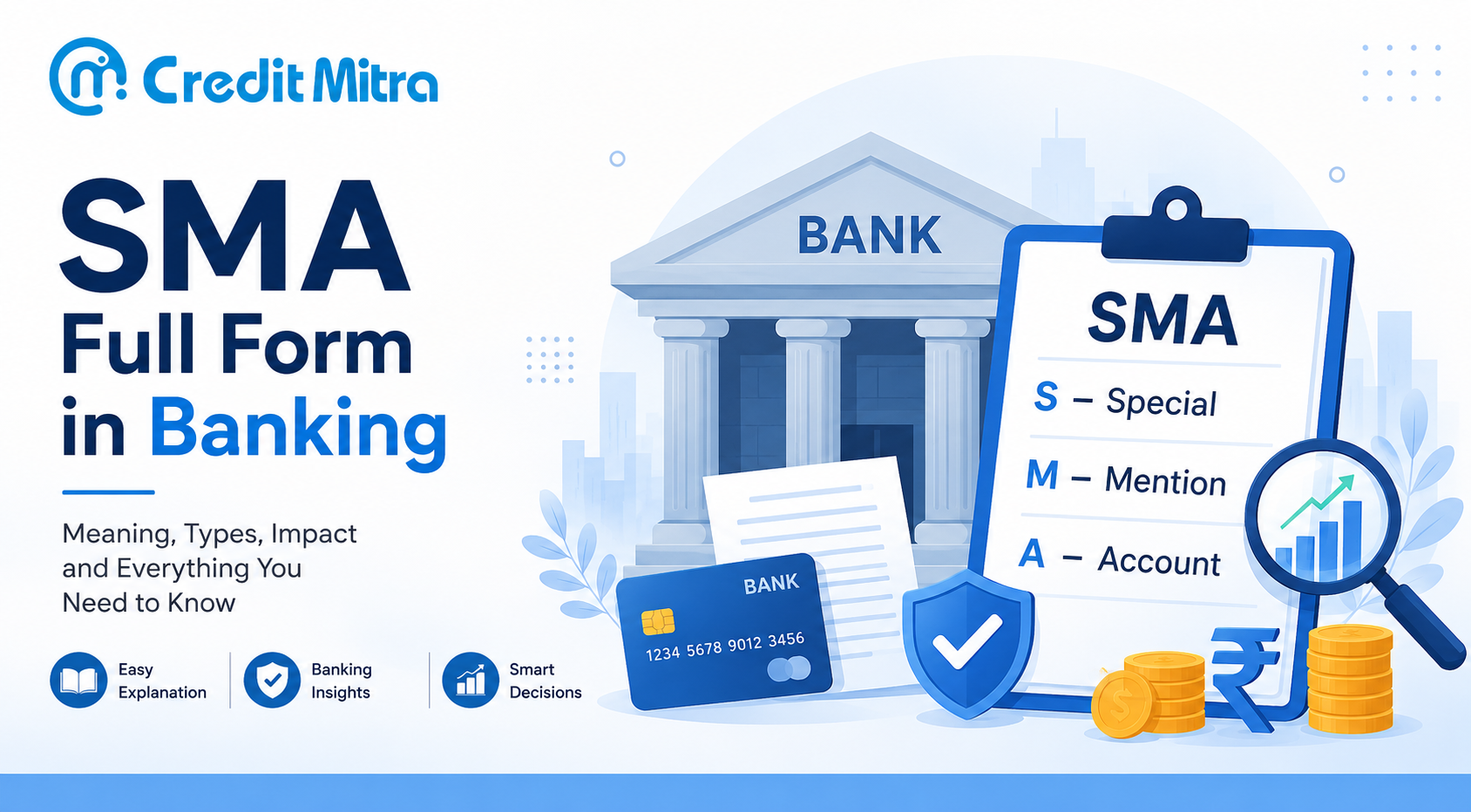
SMA stands for Special Mention Account.
In the Indian banking system, a Special Mention Account is a loan account that shows early signs of financial stress, before it officially becomes a Non-Performing Asset (NPA). The Reserve Bank of India introduced the SMA classification in 2014 to give banks (and borrowers) a structured early warning system.
Think of it this way: NPA is the red card in banking. SMA is the yellow card, a serious warning that something needs to change immediately.
The SMA classification applies to all loan types extended by banks and NBFCs, with one exception: crop season-based agricultural loans.
Why Did RBI Introduce SMA? The Banking Context
Before 2014, Indian banks could only formally identify a distressed loan after it crossed the 90-day default threshold and became an NPA. By that point, recovery was already difficult and expensive.
India's banking sector was grappling with a mounting NPA crisis, bad loans eventually crossed ₹10 lakh crore, and late identification was a key problem. The RBI's solution was to create the Special Mention Account framework: a structured early warning system that forces banks to identify and act on loan stress before the 90-day NPA clock runs out.
The classification of Special Mention Accounts was introduced by the RBI in 2014 to identify those accounts that have the potential to become NPAs. The logic is straightforward: some accounts may turn NPA soon, and early identification helps tackle the problem better.
The framework also created a reporting obligation. Lenders must report SMA accounts to the Central Repository of Information on Large Credits (CRILC) for all borrowers with aggregate exposure of ₹5 crore or more. This means if you default with one bank, other lenders can see it, the SMA flag doesn't stay between you and one lender alone.
Read More: Credit Score Vs CIBIL Score
The Four Types of SMA in Banking
SMA accounts are classified into four categories. The first three are based on overdue days; the fourth is based on behavioral signals.
SMA-0: The First Warning (1–30 Days Overdue)
SMA-0 is the category of Special Mention Account wherein principal or interest has not been overdue for more than 30 days, but the account is reflecting some incipient stress.
What it means for you: Your EMI was due but didn't get paid on time. As per RBI's 2021 circular, your account is flagged as SMA-0 on the very date of default, not after 30 days, but on day one.
Bank action: Internal monitoring intensifies. No formal communication yet, but your account is being watched.
CIBIL impact: Mild but immediate. The score may dip 20–40 points depending on your current profile.
Recovery: Pay the overdue amount immediately. SMA-0 is the easiest stage to recover from, it can clear quickly with full payment.
SMA-1: The Escalation (31–60 Days Overdue)
SMA-1 is the category wherein the principal or interest payment is overdue between 31 to 60 days.
What it means for you: You've now missed more than a month of payments. Banks are formally engaging at this stage, expect calls, branch visits, or a formal review of your account.
Bank action: Borrower engagement begins. Lenders review the account health, check for restructuring options, and escalate internally.
CIBIL impact: Significant. Scores can drop 50–80 points. Future loan applications now face higher scrutiny and rates.
Recovery: Still fully possible, pay the overdue amount and the account reverts to standard, but the window is shrinking fast.
SMA-2: The Final Warning Before NPA (61–90 Days Overdue)
In the case of SMA-2, an overdue between 61 to 90 days will make an asset SMA-2.
What it means for you: You are in the critical zone. The 91st day of default converts your account from SMA-2 to NPA. Once that happens, the damage to your credit profile becomes dramatically worse and far harder to recover.
Bank action: Intensive intervention. Restructuring offers, legal notices, and urgent outreach from lenders become common at this stage.
CIBIL impact: Severe. Scores can drop 100–150 points. Most mainstream lenders will decline applications.
Recovery: Urgent. Pay immediately. If you cannot pay the full amount, negotiate a restructuring or moratorium NOW, before day 91.
SMA-NF: The Non-Financial Warning
In the case of SMA-NF, non-financial indications about the stress of an asset are considered. These are called in banking parlance "Early Warning Signals (EWS)" intended to alert local bank management to the fact that if no corrective action is initiated on time, such accounts may turn bad.
What triggers SMA-NF:
Frequent cheque bounces or NACH mandate failures
Excessive or unusual overdraft drawings
Sharp decline in operating cash flows (business loans)
Legal notices or litigation involving the borrower
Change in management without lender notification (corporate loans)
Unusual account activity patterns
Unlike SMA-0 to SMA-2, SMA-NF is usually an internal bank classification. Borrowers may not always see it directly, but it triggers increased monitoring and can quickly lead to SMA-0 classification.
Quick Reference: All SMA Types
What SMA Does to Your CIBIL Score and Loan Eligibility
As per RBI guidelines dated 12.11.2021, delinquency will be counted from the date of EMI/interest due date. The bank's website added that delinquency is reported to CIBIL on the date of default and credit score is impacted adversely.
This means the impact is immediate, not delayed by 30 or 60 days. The moment your EMI is missed, the clock starts.
On loan approvals:
On credit limits: Even if loans are approved, credit limits will be lower. Banks price for risk, and SMA is a significant risk flag.
Across all your lenders: If you have loans with multiple banks and one reports you to CRILC, all your lenders see it. Your SMA status at Bank A affects your standing at Bank B, C, and D simultaneously.
SMA vs. NPA: The Difference You Must Understand
The critical insight: SMA is still recoverable without legal complications. NPA is recoverable but involves far heavier financial and reputational damage. If your account is SMA, act before the 91st day.
How to Remove SMA from Your Loan Account: 5 Steps
Step 1: Know Your Exact Overdue Amount
Check your CIBIL report for all SMA-flagged accounts. Call your lender directly to get the exact breakdown: principal overdue + interest + late payment charges.
Important: If you have multiple credit facilities with the same bank (two loans, a loan and a credit card), ALL must be cleared, not just one.
Step 2: Pay the Full Outstanding Amount
The only way to remove SMA from CIBIL report is to clear all overdue payments immediately. An unattended SMA status in your CIBIL report can easily lead your account to be classified as a Non-Performing Asset, leading to aggravated impact on your CIBIL score and rejection of future loan applications.
Partial payment doesn't trigger the upgrade. You need to pay in full.
Step 3: Get Written Confirmation from Your Lender
Once you pay, request a written acknowledgment from your bank confirming the payment has been received and the account is being upgraded to "Standard Asset" status. This protects you if there are delays in reporting.
Step 4: Monitor Your CIBIL Report
CIBIL typically reflects lender-reported updates within 30–45 days. Check your report monthly post-clearance. If SMA still appears after 60 days, raise a formal dispute through TransUnion CIBIL's online dispute portal.
Step 5: Build Positive History Consistently
Clearing the SMA removes the active flag but the payment history (Days Past Due record) remains visible for up to 7 years. The fastest way to rebuild your profile:
Set up auto-debit for ALL EMI payments
Avoid applying for new credit for at least 3 months post-clearance
Consistent 6–12 months of clean payments typically restores your score to the 700+ range
Once you reach 700+, use platforms like CreditMitra to compare personal loan rates and find better terms than you currently have
What If You Can't Pay Immediately?
If full payment isn't possible right now:
Request restructuring: Ask your lender to extend tenure or reduce EMI
Negotiate a moratorium: Temporary pause on payments (lender discretion)
Consider One-Time Settlement (OTS): If you're approaching SMA-2/NPA, a negotiated settlement is better than a full default
Add a co-borrower: Strengthening the account with a guarantor can buy time
SMA Full Form in Banking in Hindi
SMA का Full Form बैंकिंग में है: Special Mention Account (विशेष उल्लेख खाता)
SMA क्या है? जब कोई borrower (उधारकर्ता) अपनी EMI या ब्याज की किस्त समय पर नहीं चुकाता, तो बैंक उस खाते को Special Mention Account (SMA) में वर्गीकृत करता है। यह NPA (Non-Performing Asset) बनने से पहले की चेतावनी है।
SMA के प्रकार:
आपके CIBIL Score पर असर: SMA classification से CIBIL Score तुरंत घटता है। SMA-2 में Score 100–150 अंक तक गिर सकता है।
SMA हटाने का तरीका: बकाया राशि पूरी तरह चुकाएं → बैंक से लिखित पुष्टि लें → CIBIL Report check करें।
FAQ: Common Questions About SMA in Banking
Q: SMA 1 full form in banking क्या है?
SMA-1 का full form Special Mention Account - Category 1 है, जिसमें भुगतान 31 से 60 दिन के लिए overdue (बकाया) है।
Q: Does SMA status mean my loan is about to be cancelled?
No. SMA is a monitoring classification, not cancellation. Your loan remains active. If you pay all overdue amounts before day 90, the account reverts to Standard. The risk is inaction, if you ignore SMA-2, day 91 brings NPA status, which is far more serious.
Q: Can I get a personal loan if I have SMA on my CIBIL report?
It's challenging but not impossible. SMA-0 borrowers may qualify with some NBFCs at higher rates. SMA-1 and SMA-2 make mainstream approvals very difficult. The recommended path: clear dues → rebuild credit for 6 months → then compare options through CreditMitra to find lenders suited to your recovering profile.
Q: Is SMA reported to CIBIL?
Yes. Banks report SMA classifications to all credit bureaus (TransUnion CIBIL, CRIF HighMark, Experian). The classification appears as Days Past Due (DPD) in your credit report.
The Bottom Line: SMA Is a Warning, Not a Verdict
SMA full form in banking is Special Mention Account, and it's exactly what the name says: a special flag that something needs your attention. It's not an NPA. It's not a write-off. It's a yellow card that gives you one final chance to correct course before the situation becomes significantly worse.
The steps are clear: know your overdue amount, pay it in full, get written confirmation, monitor your CIBIL, and rebuild consistently.
If you're post-SMA and looking to access personal loans or refinance existing debt, CreditMitra helps you compare lenders across banks and NBFCs, finding options that match your current credit profile and helping you get back on track faster.
SMA is a signal. How you respond to it is entirely within your control.
About the Author

Divya
SEO Strategist & Finance WriterDivya Kumari is an SEO & Content Strategist with experience in organic traffic growth, topical authority building, and content-led SEO strategies. She specializes in creating user-focused content for finance and SaaS websites, helping brands improve visibility through structured content planning, internal linking, and search optimization techniques.
Borrow. Protect. Grow.
All in one app.
- Compare loan offers
- Buy insurance in minutes
- Invest in mutual funds
- Check credit score free
- Track all your applications


Explore More Articles

What to Do When Your Travel Budget Falls Short

How to Finance Your Dream Vacation Responsibly
On this page
- SMA Full Form in Banking: The Complete Answer
- Why Did RBI Introduce SMA? The Banking Context
- The Four Types of SMA in Banking
- Quick Reference: All SMA Types
- What SMA Does to Your CIBIL Score and Loan Eligibility
- SMA vs. NPA: The Difference You Must Understand
- How to Remove SMA from Your Loan Account: 5 Steps
- SMA Full Form in Banking in Hindi
- FAQ: Common Questions About SMA in Banking
- The Bottom Line: SMA Is a Warning, Not a Verdict
About the Author
Divya
SEO Strategist & Finance WriterDivya Kumari is an SEO & Content Strategist with experience in organic traffic growth, topical authority building, and content-led SEO strategies. She specializes in creating user-focused content for finance and SaaS websites, helping brands improve visibility through structured content planning, internal linking, and search optimization techniques.
Borrow. Protect. Grow.
All in one app.
- Compare loan offers
- Buy insurance in minutes
- Invest in mutual funds
- Check credit score free
- Track all your applications