Secured vs Unsecured Personal Loan: Complete Guide
Confused between secured and unsecured personal loans? Learn the key differences in interest rates, collateral requirements, eligibility, risks, and approval process to understand which loan option suits you better.

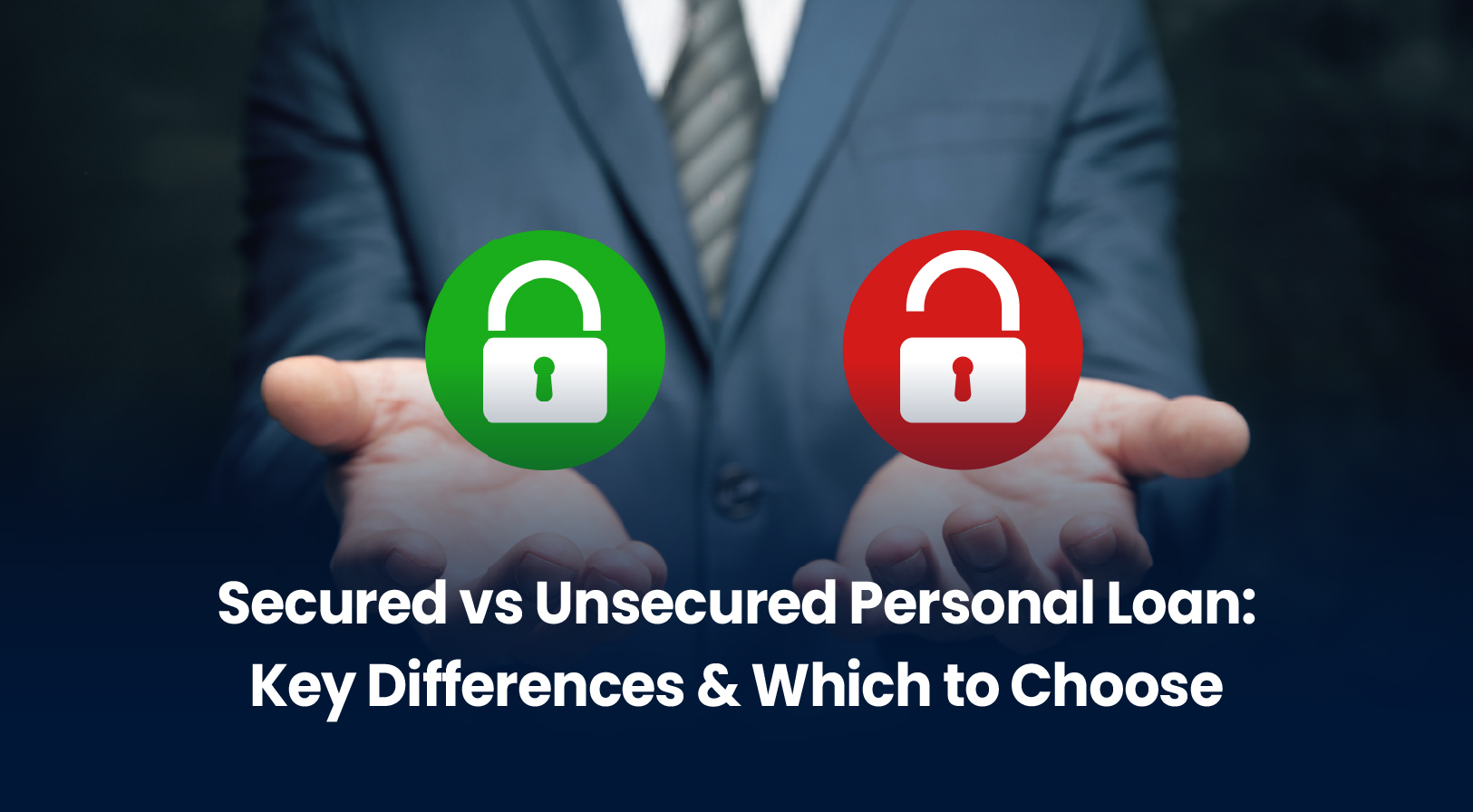
TL;DR: Secured loans require collateral (gold, FD, property) → lower interest (8-12%), higher amounts, but you risk losing assets. Unsecured loans need no collateral → instant approval, but higher interest (14-24%), strict CIBIL score (700+). Choose secured for ₹10L+ needs or low CIBIL scores. Choose unsecured for speed and small amounts. Your CIBIL score and urgency matter most.
Quick Comparison Table
| Feature | Secured Loan | Unsecured Loan |
| Collateral | Required (Gold, FD, Property) | Not required |
| Interest Rate | 8-12% | 14-24% |
| Loan Amount | Up to ₹50L+ | ₹1L-₹20L typically |
| Approval Time | 5-15 days | 2-5 minutes to 48 hours |
| CIBIL Score Needed | 600+ (flexible) | 700+ (strict) |
| Documentation | Heavy (asset proofs) | Minimal (Aadhaar, PAN, salary slip) |
| Risk to You | Asset seizure if default | Credit score damage |
| Best For | Large amounts, low CIBIL | Quick need, asset protection |
What is a Secured Personal Loan?
Simple definition: A secured personal loan is a loan backed by collateral—something valuable you pledge to the lender.
If you don’t repay, the lender can seize and sell that asset to recover their money.
Common collateral in India:
- Gold (most popular—quick valuation, ₹50K-₹10L)
- Fixed Deposits (safe, continues earning interest)
- Property (largest amounts, ₹10L-₹50L+)
- Securities/Mutual Funds (liquid, quick approval)
- Life Insurance Surrender Value
Key advantages:
- Lower interest rates (8-12% vs 14-24%)
- Higher loan amounts (₹50L possible)
- CIBIL score not critical (600+ acceptable)
- Longer repayment (5-20 years, lower EMI)
Key disadvantages:
- Risk losing your asset
- Slower approval (5-15 days for valuation)
- More documentation
- Emotional stress of pledging assets
Best for: Large expenses (home renovation ₹20L+, business expansion ₹15L+), people with low CIBIL scores (below 700), those wanting lowest interest rates.
What is an Unsecured Personal Loan?
Simple definition: An unsecured personal loan is a collateral-free loan approved based on your creditworthiness—CIBIL score, income, employment, and repayment history.
No assets are at risk. The lender’s only recourse if you default is legal action.
Approval based on:
- CIBIL score (primary factor, 700+ preferred)
- Monthly income
- Employment stability
- Existing debt levels
- Bank account history
Key advantages:
- Instant approval (minutes to hours)
- No collateral needed (assets stay with you)
- Minimal documentation
- 100% digital process (apply via phone)
- Flexible use (no purpose restrictions)
Key disadvantages:
- Higher interest rates (14-24%)
- Strict CIBIL score requirement (700+ typically)
- Smaller loan amounts (₹1L-₹20L)
- Penalties for default (credit score drops 100+ points)
Best for: Emergencies (medical ₹2L, travel ₹1L), small-medium needs (wedding ₹5L, education ₹3L), people with good CIBIL scores (700+), those wanting instant approval.
Read More: How to Get a Personal Loan Approved Fast in India
Detailed Comparison: 7 Key Differences
1. Interest Rate (Most Impactful)
Secured: 8-12% annually
Unsecured: 14-24% annually
Impact example:
- Loan: ₹5 lakhs for 5 years
- Secured @ 10%: Total interest ₹1,37,000
- Unsecured @ 15%: Total interest ₹2,03,000
- Difference: ₹66,000 saved with secured
For large amounts (₹20L+) or long tenures (7+ years), this difference is ₹2-₹5 lakhs.
2. Loan Amount
Secured: ₹25 lakh to ₹50 lakh+ (based on collateral value)
Unsecured: ₹1 lakh to ₹20 lakh (based on income)
If you need ₹30 lakhs, secured is your only option.
3. Approval Time
Secured: 5-15 days (asset valuation takes time)
Unsecured: 2-5 minutes (instant) to 48 hours (includes disbursement)
Fintech platforms like CreditMitra approve unsecured loans in minutes.
4. CIBIL Score Requirement
Secured: 600+ (very flexible, collateral compensates)
Unsecured: 700+ (strict, credit score is your guarantee)
This is crucial: If your CIBIL is below 700, you likely can’t get unsecured loans. Secured becomes your option.
5. Documentation
Secured:
- Collateral proofs (property deed, gold cert, FD receipt)
- Valuation report
- Ownership documents
- Takes 3-5 days
Unsecured:
- Aadhaar
- PAN
- Last 2 salary slips OR 6 months bank statements
- Instant (can be submitted online)
6. Repayment Tenure
Secured: 5-20 years (manageable EMIs)
Unsecured: 1-5 years (shorter, higher EMIs)
Lower EMI on secured helps cash flow for large loans.
7. Risk Profile
Secured: High risk to YOU (asset loss) | Low risk to lender
Unsecured: Low risk to YOU (no asset loss) | High risk to lender
India-Specific Context: CIBIL Score & Collateral
CIBIL Score Impact on Loan Type
Your CIBIL score determines which loan you can actually access:
If CIBIL < 650:
- Unsecured: Rejected (almost always)
- Secured: Approved (collateral overcomes weak score)
- Action: Choose secured loan
If, CIBIL 650-700:
- Unsecured: Difficult (higher interest, strict docs)
- Secured: Easy approval
- Action: Secured is better option
and, If CIBIL > 700:
- Unsecured: Easy approval, competitive rates
- Secured: Still option, but unnecessary
- Action: Choose unsecured for speed
If CIBIL > 750:
- Unsecured: Best rates, instant approval
- Secured: Only if you want lower rates
- Action: Unsecured is ideal choice
Real-Life Scenarios: Which Loan?
1: Emergency Medical Bill (₹2 lakhs)
- Timeframe: Urgent (need in 24 hours)
- CIBIL: 700
- Decision: Unsecured (instant approval, no time for secured valuation)
- EMI: ~₹4,200/month for 5 years @ 15%
2: Home Renovation (₹20 lakhs)
- Timeframe: Can wait 2 weeks
- CIBIL: 650 (low)
- Decision: Secured (lower rate compensates for low CIBIL, large amount)
- EMI: ~₹18,000/month for 5 years @ 10% vs ₹21,000 @ 15%
- Savings: ₹1,80,000 over loan term
3: Wedding Expenses (₹5 lakhs)
- Timeframe: Known 3 months in advance
- CIBIL: 750 (excellent)
- Decision: Unsecured (instant approval, good rate due to excellent CIBIL)
- EMI: ~₹10,600/month for 5 years @ 15%
- Why not secured? Not worth the hassle and delay for this amount
Scenario 4: Business Expansion (₹15 lakhs), Self-Employed, CIBIL 640
- Timeframe: 2 weeks available
- CIBIL: 640 (low, self-employed)
- Decision: Secured (low CIBIL makes unsecured difficult; you have time)
- EMI: ~₹14,200/month for 5 years @ 10%
How to Choose: Decision Framework
Answer these 4 questions:
Q1: How urgent is your need?
- Within 24 hours: Unsecured (instant approval)
- Within 1 week: Unsecured (possible)
- 1-2 weeks: Either (secured valuation completes)
- 2+ weeks: Secured (more time, better rates)
Q2: How much do you need?
- ₹1-₹5 lakh: Unsecured (faster, simpler)
- ₹5-₹10 lakh: Either (consider CIBIL score)
- ₹10-₹20 lakh: Either (consider CIBIL score)
- ₹20+ lakh: Secured (unsecured rarely available)
Q3: What is your CIBIL score?
- Below 650: Secured (unsecured rejected)
- 650-700: Secured (easier access)
- 700-750: Either (unsecured now possible)
- 750+: Unsecured (best rates, fastest approval)
Q4: Can you afford to risk losing the asset?
- NO (prefer safety): Unsecured (no asset risk)
- YES (have collateral): Secured (lower cost)
Your decision:
- 3+ answers point to unsecured → Choose unsecured
- 3+ answers point to secured → Choose secured
Cost Comparison: Real Numbers
Example 1: ₹5 Lakh for 5 Years
| Parameter | Secured @ 10% | Unsecured @ 15% |
| Monthly EMI | ₹9,540 | ₹10,630 |
| Total Payment | ₹5,72,400 | ₹6,37,800 |
| Total Interest | ₹72,400 | ₹1,37,800 |
| Total Savings | — | ₹65,400 with secured |
Example 2: ₹1 Lakh for 2 Years
| Parameter | Secured @ 10% | Unsecured @ 18% |
| Monthly EMI | ₹4,505 | ₹4,785 |
| Total Payment | ₹1,08,120 | ₹1,14,840 |
| Total Interest | ₹8,120 | ₹14,840 |
| Total Savings | — | ₹6,720 with secured |
Key insight: As amount increases, interest savings compound dramatically. For ₹20L over 7 years, difference could be ₹3-₹5 lakhs.
FAQs
Q: Which loan builds my CIBIL score better?
Both equally help if you make on-time payments. Unsecured loans may have slight edge (higher risk factor = more credit value). But consistency matters most.
Q: Can I convert from unsecured to secured (or vice versa)?
No. You’d need to repay the original loan and take a new one. Not recommended due to processing costs and impact.
Q: What if I can’t repay a secured loan?
The lender seizes your asset (gold, FD, property) within 90+ days of default. They auction it to recover the loan. You lose the asset permanently. Your CIBIL score also drops 100+ points.
Q: Can I get unsecured with low CIBIL?
Difficult. Most lenders require 700+. Some NBFCs may approve 650+, but at 20-24% interest (very expensive). Better to improve CIBIL first or choose secured.
Q: What’s the best collateral for secured loans?
Gold is fastest (1-2 days), easiest valuation. FD is safest (low loss, continues earning). Property gives largest amounts but takes longest (10-15 days).
Finding the Right Lender in India
Secured Loans
- Banks: SBI, HDFC, ICICI, AXIS (safer, slower)
- NBFCs: Bajaj, Shriram, Home Credit (faster)
- Fintech: CreditMitra (instant comparison)
Unsecured Loans
- Banks: Slower approval (2-3 days)
- NBFCs: Faster, flexible eligibility
- Fintech: Fastest (minutes), 100% digital
Best approach: Compare offers on CreditMitra to see all options (banks, NBFCs, fintech) in one place. Find the best rate for your CIBIL score and loan amount.
Final Verdict
Choose Secured If:
- Need ₹10L+
- CIBIL below 700
- Want lowest possible interest
- Can wait 1-2 weeks
- Have valuable assets
Choose Unsecured If:
- Need money urgently (within 24 hours)
- Need ₹1-₹20L
- CIBIL 700+ (strong score)
- Don’t want asset risk
- Prefer 100% digital process
The bottom line: There’s no universal “best” choice. Your CIBIL score, urgency, loan amount, and risk tolerance determine the right option.
Compare offers from multiple lenders on CreditMitra to see which loan type and which lender gives you the best terms.
About the Author

Divya Kumari
SEO Strategist & Finance WriterDivya Kumari is an SEO & Content Strategist with experience in organic traffic growth, topical authority building, and content-led SEO strategies. She specializes in creating user-focused content for finance and SaaS websites, helping brands improve visibility through structured content planning, internal linking, and search optimization techniques.
Borrow. Protect. Grow.
All in one app.
- Compare loan offers
- Buy insurance in minutes
- Invest in mutual funds
- Check credit score free
- Track all your applications


Explore More Articles

What to Do When Your Travel Budget Falls Short

How to Finance Your Dream Vacation Responsibly
On this page
- Quick Comparison Table
- What is a Secured Personal Loan?
- What is an Unsecured Personal Loan?
- Detailed Comparison: 7 Key Differences
- India-Specific Context: CIBIL Score & Collateral
- Real-Life Scenarios: Which Loan?
- How to Choose: Decision Framework
- Cost Comparison: Real Numbers
- FAQs
- Finding the Right Lender in India
- Final Verdict
About the Author
Divya Kumari
SEO Strategist & Finance WriterDivya Kumari is an SEO & Content Strategist with experience in organic traffic growth, topical authority building, and content-led SEO strategies. She specializes in creating user-focused content for finance and SaaS websites, helping brands improve visibility through structured content planning, internal linking, and search optimization techniques.
Borrow. Protect. Grow.
All in one app.
- Compare loan offers
- Buy insurance in minutes
- Invest in mutual funds
- Check credit score free
- Track all your applications