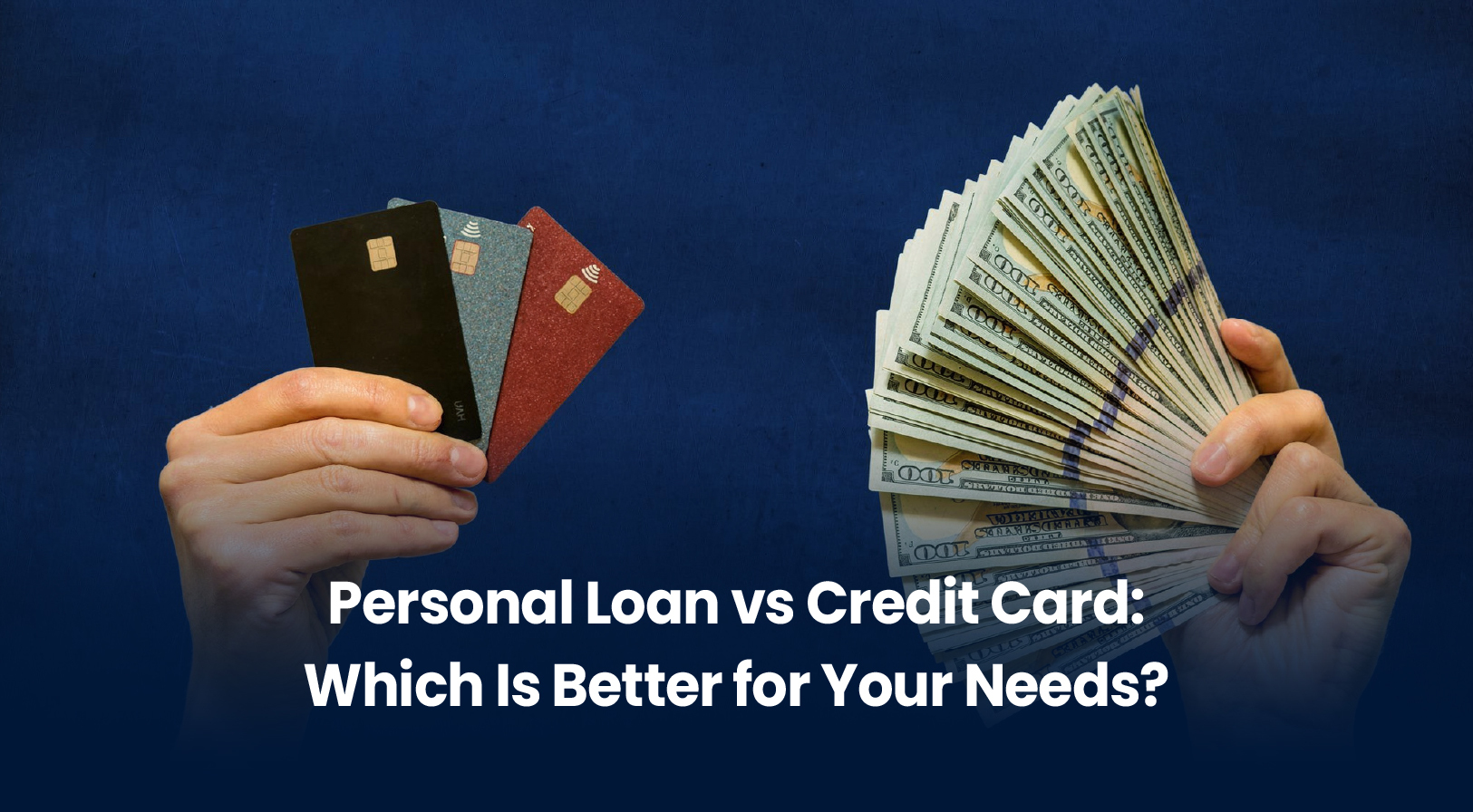
Personal Loan vs Credit Card: Which Is Actually Cheaper?
Personal loans and credit cards both provide access to quick funds, but they differ in repayment structure, interest rates, credit limits, and usage. This guide compares personal loan vs credit card options to help borrowers choose the better solution for emergencies, large expenses, EMIs, and short-term financial needs.

You need ₹3 lakh urgently.
Now, You have two options:
- Credit Card EMI: Convert purchase to 36-month EMI
- Personal Loan: Borrow ₹3 lakh over 36 months
You think: “EMI is instant, personal loan takes time. Both have EMI, so cost is probably similar.”
You’re wrong. The cost difference is ₹81,700.
This is what most Indians don’t realize, credit card EMI looks convenient but costs 2-3x more than a personal loan. Here’s the complete breakdown showing which option actually saves you money, protects your credit score, and fits your financial situation.
Quick Verdict: Personal Loan Wins in 90% of Scenarios
For amounts >₹50,000, personal loans are almost always cheaper than credit card EMI. The only exception: genuine no-cost EMI offers (rare and true zero interest). Even then, hidden fees usually offset the benefit.
Interest Rate Comparison: The Core Difference
Personal Loans (May 2026):
- HDFC: 9.99%-18%
- ICICI: 9.99%-16.50%
- SBI: 10%-15%
- Axis: 8.95%-14.99%
- Average for good credit: 10-13%
Credit Card EMI (May 2026):
- Standard EMI: 18%-36% p.a.
- Advertised minimum: 13%-18%
- Effective rate (after GST): 24%-42% p.a.
- Revolving credit: 30%-42% p.a. (charged if balance unpaid)
The gap: 8-20% difference. On ₹3 lakh, this is ₹82K+ in extra interest.
Real Cost Example: ₹3 Lakh Over 3 Years
Let’s calculate actual costs for a realistic scenario:
Personal Loan Option
- Amount: ₹3,00,000
- Rate: 12% p.a. (typical for 750+ CIBIL)
- Tenure: 36 months
- Monthly EMI: ₹10,632
- Total interest: ₹1,07,164
- Processing fee: ₹3,000-5,000
- Total cost: ₹1,10,164
Credit Card EMI Option
- Amount: ₹3,00,000
- Rate: 24% p.a. (typical for credit card)
- Tenure: 36 months
- Monthly EMI: ₹11,895
- Total interest: ₹1,89,864
- Processing fee: ₹2,000-3,000
- GST on fee: 18%
- Total cost: ₹1,91,864
Difference: ₹81,700 MORE EXPENSIVE with credit card
On a ₹5 lakh loan over 3 years, personal loan saves ₹1,35,000+.
Even on smaller ₹1 lakh amounts, personal loan saves ₹25,000-30,000.
Read More: Best Personal Loan Apps in India 2026
10-Point Comparison Table
| Factor | Personal Loan | Credit Card EMI |
| Interest Rate | 10%-18% | 18%-36% |
| Typical Rate | 12% | 24% |
| Processing Fee | ₹3-5K | ₹2-3K |
| EMI on ₹3L (36mo) | ₹10,632 | ₹11,895 |
| Total Cost (₹3L) | ₹1,10,164 | ₹1,91,864 |
| Savings | Base | -₹81,700 |
| CIBIL Impact | Zero | -50-100 points |
| Card Utilization | None | 60% |
| Approval Time | 2-24 hours | Instant |
| Flexibility | Use funds freely | Only for that purchase |
When Credit Card EMI Actually Makes Sense
Credit card EMI wins only in very specific scenarios:
- Genuine 0% EMI (rare): True zero interest, zero processing fee, zero hidden charges. Retailer absorbs cost.
- Emergency ₹5-20K: Immediate need, no time for personal loan, quick repayment planned (90 days max).
- Short tenure (3-6 months): Small amount, planned repayment, don’t care about interest.
- Existing credit card user with instant access: Already have card limit, no application friction.
In reality, <10% of credit card EMI transactions fit these criteria. Most people use it by default, not by calculation.
When Personal Loan Is Better
Personal loans win when:
- Amount >₹50,000: The interest gap widens dramatically. ₹50K at credit card = ₹12K extra cost. ₹1L = ₹25K extra cost.
- Tenure >12 months: Longer duration multiplies interest savings. 3-year personal loan saves ₹80K+.
- CIBIL matters: Credit card EMI damages your score; personal loan helps it if you repay on time.
- Flexibility needed: Personal loan money can be used for any purpose. Credit card EMI locks funds to specific purchases.
- Large purchase at high discount: HDFC laptop on EMI at 2% discount vs cash. Using a personal loan at 12% interest still makes sense financially.
The CIBIL Score Impact: Credit Card EMI Is Dangerous
This is where credit card EMI becomes a serious problem:
Credit Card EMI:
- Uses your credit limit (₹3L EMI on ₹5L limit = 60% utilization)
- Utilization >30% damages CIBIL 50-100 points
- Damages score for 12-24 months
- Future loans cost 2-3% more (₹5K-10K extra on ₹2L loan)
- Sustained high utilization = permanent credit damage
Personal Loan:
- Doesn’t use credit card limit
- Maintains available credit for emergencies
- On-time repayment improves CIBIL score
- Better for long-term credit health
Using credit card EMI for ₹3L can damage your CIBIL so severely that future loans cost ₹15-20K more due to higher rates. Added to the ₹81K interest difference, you’re ₹100K+ worse off.
The “No-Cost EMI” Trap
Banks advertise “0% EMI” aggressively. Here’s the reality:
Advertised: 0% interest, ₹50,000 becomes ₹50,000 over 12 months
Hidden costs:
- Processing fee: 1%-3% (deducted upfront)
- GST on fee: 18%
- Lost cashback: 2%-5% (you forgo store cashback)
- Lost rewards: Additional points forgone
Real example: ₹50,000 purchase
- Advertised: 0% EMI
- Processing fee: ₹1,500 (3%)
- GST: ₹270
- Lost cashback: ₹2,500 (5% typical)
- Actual cost: ₹4,270
Meanwhile, using a personal loan:
- ₹50,000 at 12% over 12 months = ₹2,700 interest
- Processing fee: ₹500
- Total cost: ₹3,200
Even with “no-cost EMI,” personal loans might be cheaper.
Processing Fees & Additional Costs
Personal Loan:
- Bajaj Finance: 0.5%-2.5% + GST
- HDFC: ₹6,500 + GST
- ICICI: up to 2% + GST
- SBI: 0.5%-1% + GST
Credit Card EMI:
- Varies by card: 1%-3% (deducted from limit)
- GST on fee: 18%
- Plus lost rewards/cashback
Personal loans are more transparent. Credit cards hide costs in “no-cost EMI” marketing.
How to Calculate Which Is Actually Cheaper
Step 1: Know the rates
- Personal loan rate (check CreditMitra for your actual rate)
- Credit card rate (call your bank)
Step 2: Calculate total interest
- Personal loan: (EMI × tenure) – principal = interest
- Credit card: Same formula but starting from day 1 (no grace period)
And, Step 3: Add all fees
- Processing fee (personal)
- GST on fee
- Lost cashback (credit card)
- Future CIBIL damage cost (credit card)
Step 4: Compare totals
- If personal loan <credit card: choose personal loan
- If credit card <personal loan (very rare): choose credit card
CreditMitra’s calculator does this automatically, showing actual cost comparison without having to calculate.
Personal Loan via CreditMitra vs Direct Bank Application
Traditional (Costly):
- Apply to Bank A (hard inquiry)
- Apply to Bank B (hard inquiry)
- Apply to Bank C (hard inquiry)
- Total: 3 hard inquiries = CIBIL drops 15-30 points
- Best rate: ₹1,10,000 cost
- Future loans cost 2-3% more (₹5-10K damage)
CreditMitra (Smart):
- One soft inquiry (zero CIBIL damage)
- See rates from HDFC (9.99%), ICICI (9.99%), SBI (10%), Axis (8.95%), 30+ others
- Compare total cost on calculator
- Choose lowest rate: ₹1,08,500 cost
- Apply once (one hard inquiry only)
- Savings: 15-30 CIBIL points + ₹1,500 interest difference = ₹6-12K total value
Using an aggregator for personal loans is smarter than direct applications.
FAQ: Your Most Common Questions
Q: Which is faster, credit card EMI or personal loan?
A: Credit card EMI instant (deducted from limit). A personal loan takes 2-24 hours depending on the lender. If you can wait 2 hours, a personal loan is worth it (saves ₹80K+).
Q: What if I have low CIBIL and can’t get a personal loan?
A: Credit card EMI is still possible but expensive at 28-36% rate. Better: spend 6-12 months improving CIBIL, then apply for a personal loan at 16-18% instead.
Q: Can I use a personal loan to pay off my credit card EMI?
A: Yes, perfect strategy. Personal loan at 12% pays off credit card at 24% = saves ₹12K+ immediately. Also clears credit utilization, protects CIBIL.
Q: Is no-cost EMI truly free?
A: Almost never. Processing fee, GST, lost cashback add up. Read the fine print carefully.
Q: Does credit card EMI show on CIBIL?
A: Yes, it increases credit utilization on your report, damaging scores 50-100 points if sustained.
Q: Should I ever choose credit card EMI over personal loan?
A: Only for <₹20K genuine emergencies or true 0% EMI with proven hidden fees. Otherwise, personal loan is smarter financially and for credit health.
Conclusion: Do the Math, Choose the Cheaper Option
Personal loans are cheaper 90% of the time. But don’t assume, calculate your specific scenario:
- How much do you need?
- How long to repay?
- What rate would you get?
Use CreditMitra’s calculator to compare actual costs. The soft inquiry takes 2 minutes. The savings take 6-12 months to realize: ₹25K-80K+.
Stop making financial decisions based on convenience. Make them based on math.
About the Author

Divya Kumari
SEO Strategist & Finance WriterDivya Kumari is an SEO & Content Strategist with experience in organic traffic growth, topical authority building, and content-led SEO strategies. She specializes in creating user-focused content for finance and SaaS websites, helping brands improve visibility through structured content planning, internal linking, and search optimization techniques.
Borrow. Protect. Grow.
All in one app.
- Compare loan offers
- Buy insurance in minutes
- Invest in mutual funds
- Check credit score free
- Track all your applications


Explore More Articles

What to Do When Your Travel Budget Falls Short

How to Finance Your Dream Vacation Responsibly
On this page
- Quick Verdict: Personal Loan Wins in 90% of Scenarios
- Interest Rate Comparison: The Core Difference
- Real Cost Example: ₹3 Lakh Over 3 Years
- 10-Point Comparison Table
- When Credit Card EMI Actually Makes Sense
- When Personal Loan Is Better
- The CIBIL Score Impact: Credit Card EMI Is Dangerous
- The “No-Cost EMI” Trap
- Processing Fees & Additional Costs
- How to Calculate Which Is Actually Cheaper
- Personal Loan via CreditMitra vs Direct Bank Application
- FAQ: Your Most Common Questions
- Conclusion: Do the Math, Choose the Cheaper Option
About the Author
Divya Kumari
SEO Strategist & Finance WriterDivya Kumari is an SEO & Content Strategist with experience in organic traffic growth, topical authority building, and content-led SEO strategies. She specializes in creating user-focused content for finance and SaaS websites, helping brands improve visibility through structured content planning, internal linking, and search optimization techniques.
Borrow. Protect. Grow.
All in one app.
- Compare loan offers
- Buy insurance in minutes
- Invest in mutual funds
- Check credit score free
- Track all your applications