NOC Full Form: What Is NOC Certificate
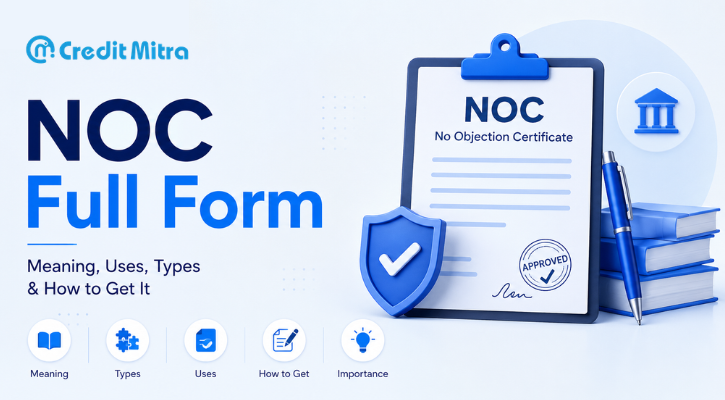
NOC stands for No Objection Certificate, an official document that confirms a person or organization has no objection to a specific transaction or activity. This guide explains the NOC full form, its importance in banking, loans, property transfers, vehicle ownership, and when you need an NOC from a bank.

Finally, you made your last EMI payment. The repayment period of five years is now completed.
You feel relieved. Life goes on.
Then, after three years, you decide to sell your property or apply for another loan. The bank informs you that you have an active loan registered under your name. Or that the property is registered in the name of the previous lender.
You wonder. I have paid everything. What is wrong?
You didn't get your NOC.
One missing document and all those years of disciplined EMI payments will be rendered meaningless!
NOC Full Form in Banking
What does NOC stand for? It is the term which refers to the legal document known as 'No Objection Certificate' which is issued by banks or financial institutions confirming that they have no objection to the closure of the loan.
NOC full form in simple words is "This borrower owes us nothing. The loan is closed. There are no claims."
A No Objection Certificate or No Dues Certificate is a legal document which proves the repayment of the loan.
The NOC is alternatively called:
No Dues Certificate (NDC)
Loan Closure Certificate
Clearance Certificate
All terms are interchangeable.
Why NOC Is More Important Than You May Think
The most common mistake that majority of Indians make after repaying their loan is assuming the loan is "done" after making the last EMI payment.
But it isn't.
Consider that after several years of repaying your home loan or car loan, finally, you are done with it. But later, while selling the property or applying for another loan, you realize that there is an existing liability in your name. Reason? You have not received the NOC from your bank!
What Is an NOC Letter?
An NOC or NOC letter stands for a No Objection Certificate which is a formal document issued by the financial institution when you have repaid the loan. It is essentially an acknowledgment from the financial institution that there are no objections to fully settling the loan. This letter is legally binding and serves as a proof that you have fulfilled your financial commitment.
A typical NOC letter contains the following information:
Name of the borrower (according to loan documentation)
Account number of the loan
Type of the loan (personal loan, home loan, car loan, etc.)
Original loan amount
Date of closing the loan
Statement confirming that all dues have been paid
Signature and official stamp of the bank
Date of issuing NOC
Details of the asset (for secured loans)
Make sure to keep the document forever because it might become necessary for you even many years later.
NOC in Banking: Five Important Uses
1. Proof of Repayment of the Loan
Issuing the NOC means that the bank acknowledges that you have completed your financial obligation. Without this certificate, any disputes or misunderstanding regarding non-payment of any dues could arise in the future. With NOC, it becomes possible to protect yourself against such disputes as it prevents the lender from raising any more claims.
Real-life scenario: Due to an error on the part of a bank employee, your loan was marked as "partially unpaid." Without NOC, you couldn't prove closure of the loan. With NOC, the issue was solved within one day.
2. Update CIBIL Score
While issuing the NOC, the bank informs the credit bureau like CIBIL about the fact that the loan has been fully repaid. In turn, the credit report is updated. If this step is skipped or postponed, the loan will remain active in the report which would negatively impact your creditworthiness when applying for another loan.
Practical impact: Active closed loan in the credit report decreases the amount of credit capacity left.
3. Remove Hypothecation (Car Loans)
If you borrowed money for a vehicle, then its Registration Certificate (RC) will show the name of the lender. For updating the registration in the records of the Regional Transport Office (RTO), it is necessary to have NOC.
Without NOC:
The RC of the car or bike will show the name of the bank as a co-owner.
You won't be able to sell the vehicles, change their ownership or purchase new insurance.
With NOC:
Present the NOC to the RTO.
Hypothecation is removed.
The RC is updated to your name only.
The vehicle becomes completely yours.
4. Release of Property Documents (Home Loans)
For the home loans, the bank retains the original property documents (sale deed, title deed) until the end of the loan tenure as security.
According to the RBI's notification of 13 September 2023, for cases when the document release should take place on or after 1 December 2023, banks are required to return all the original property documents within 30 days after the loan closure. Otherwise, they are liable to pay compensation to the borrower.
Without NOC:
The original property documents are retained by the bank.
You won't be able to sell, refinance or mortgage this property elsewhere.
With NOC:
Within 30 days, the bank returns all the original documents to you.
The property belongs completely to you.
5. Application for Future Loans
The bank asks for the NOC certificate and other documents if you need to borrow money from them. In fact, the NOC is the document which informs the bank that you have not withdrawn a loan from any other lender.
NOC Certificate: When Do You Need It?
Read More: What is a Credit Report? To secure this essential document, follow a few simple steps: Complete Repayment (ensure you've repaid the entire loan amount and any additional charges). Contact Your Financial Institution (reach out to your loan provider and express your intent to obtain a Loan NOC). Submit Necessary Documents (provide required documents, such as the loan closure letter and the final repayment receipt). Clear Outstanding Dues (confirm that no outstanding dues or pending payments are linked to your loan account). Complete Verification Process (the financial institution may conduct a final verification to ensure all formalities are complete)., Detailed process: Step 1: Confirm Final EMI Payment Wait for last EMI to clear from your account Verify it's been 3-5 working days after final payment Ensure no bounce/rejection of last EMI Step 2: Contact Your Lender Online: Log in to bank/lender's app or website → "Loan" section → "Request NOC" Offline: Visit branch with final payment receipt + ID proof Phone: Call customer care, request NOC issuance Step 3: Submit Documents Final payment receipt or bank statement Loan account number ID proof (PAN + Aadhaar) Loan closure request letter (some banks require) Step 4: Verification Bank verifies all dues cleared (including any processing fees, bounce charges) Takes 7-30 working days Step 5: Receive NOC Physical NOC posted to registered address Digital NOC via email or app download Some lenders offer online NOCs for loans obtained online. Other lenders require you to approach the bank and request the NOC in person., RBI guideline: For secured loans, banks must return property documents within 30 days of closure. Delay = bank liable to pay compensation. If not received in time: Send a written request to the bank. If still delayed, escalate to the bank's grievance officer. If unresolved, complaint to the RBI Banking Ombudsman. Simplest. All digital: Final EMI clears → 7-15 days → NOC via email Keep for CIBIL disputes and future loan applications Verify CIBIL updates "Closed" status within 30-45 days of receiving NOC Most complex. Multiple documents involved: Request NOC + original property documents simultaneously Bank returns: Sale deed, title deed, chain of documents, NOC letter Submit NOC to local municipality/registrar if needed Update property tax records if required It safeguards you from unnecessary claims by banks regarding the repaid loan., Two-step process: Get NOC from lender (7-15 days) Visit RTO with NOC + Form 35 (hypothecation termination) + RC + insurance RTO removes hypothecation from RC (takes 15-30 days) New RC issued without lender's name Without completing the RTO step, even with NOC in hand, your RC still shows the bank's name. Real risks of skipping NOC: 1. CIBIL shows active loan indefinitely Reduces future borrowing capacity Lenders see "open" obligation → higher rates offered Fix requires NOC + dispute with CIBIL (takes 30-45 days) 2. Can't sell property/vehicle Buyer requires clear title Bank name on RC/property documents = deal blocked Costs months of legal work without NOC 3. Legal disputes An NOC is a critical legal document that proves your loan is fully repaid, freeing you from any claims by the bank. Without it, you may face legal hurdles, trouble updating your credit score, and difficulties in selling or transferring ownership of your asset., 4. Future loan applications complicated New banks question open obligations Need to explain and prove closure without NOC Some banks reject applications until NOC provided You can approach your lender to reissue a duplicate copy. There may be a formal process and fee involved., Process for duplicate NOC: Contact original lender Submit request with loan account number + ID proof Bank verifies records (7-15 days) Duplicate NOC issued (₹100-500 fee typically) If lender no longer exists (merged bank, closed NBFC): Approach the acquiring bank or CIBIL with payment proof Prevention: Scan and save NOC immediately when received. Email a copy to yourself. Store original safely. Q: Does the bank automatically send NOC after loan closure? Q: Is NOC required for prepaid or foreclosed loans too? Q: How is NOC different from loan closure letters? Q: Can NOC help remove errors from CIBIL report? Q: What if my lender's bank has merged with another bank? Q: Do I need NOC for a personal loan if no property was involved? How to Get NOC from Bank: Step-by-Step
How Long Does NOC Take After Loan Closure?
NOC for Different Loan Scenarios
Personal Loan NOC
Home Loan NOC (Most Critical)
Car Loan NOC (RTO Process)
What Happens If You Don't Get NOC?
Can You Get Duplicate NOC If Lost?
FAQ: NOC Certificate Questions Answered
A: Banks and NBFCs usually send the NOC to the address mentioned in the loan application., But many don't, especially for personal loans. Always request proactively. Don't assume it will arrive.
A: Yes, even if the loan is prepaid or foreclosed before tenure, a NOC is still required to certify that the account has been closed completely., Foreclosure NOC is equally important.
A: Loan closure letter confirms the last payment received. NOC confirms no further claims or dues exist. NOC is legally stronger, get both, but NOC is the more critical document.
A: In case the information about your loan closure is not updated in your credit report, you can submit the NOC to the credit bureau as proof and get your information updated, thus improving your credit score., NOC is your strongest weapon for CIBIL disputes.
A: Approach the acquiring bank (example: if Dena Bank merged with Bank of Baroda, approach BoB). They hold all old records. The process may take longer (21-45 days).
A: Yes. Even for unsecured personal loans, NOC confirms closure, helps CIBIL update, and protects against future disputes from lenders.
About the Author

Divya
SEO Strategist & Finance WriterDivya Kumari is an SEO & Content Strategist with experience in organic traffic growth, topical authority building, and content-led SEO strategies. She specializes in creating user-focused content for finance and SaaS websites, helping brands improve visibility through structured content planning, internal linking, and search optimization techniques.
Borrow. Protect. Grow.
All in one app.
- Compare loan offers
- Buy insurance in minutes
- Invest in mutual funds
- Check credit score free
- Track all your applications


Explore More Articles
7 Days Loan App: Real Cost, Risks and Safer Options

What to Do When Your Travel Budget Falls Short
On this page
- NOC Full Form in Banking
- Why NOC Is More Important Than You May Think
- What Is an NOC Letter?
- NOC in Banking: Five Important Uses
- NOC Certificate: When Do You Need It?
- How to Get NOC from Bank: Step-by-Step
- How Long Does NOC Take After Loan Closure?
- NOC for Different Loan Scenarios
- What Happens If You Don't Get NOC?
- Can You Get Duplicate NOC If Lost?
- FAQ: NOC Certificate Questions Answered
About the Author
Divya
SEO Strategist & Finance WriterDivya Kumari is an SEO & Content Strategist with experience in organic traffic growth, topical authority building, and content-led SEO strategies. She specializes in creating user-focused content for finance and SaaS websites, helping brands improve visibility through structured content planning, internal linking, and search optimization techniques.
Borrow. Protect. Grow.
All in one app.
- Compare loan offers
- Buy insurance in minutes
- Invest in mutual funds
- Check credit score free
- Track all your applications