What is a Credit Report? Simple Definition and Guide
This complete credit report guide explains what a credit report is, how credit bureaus like CIBIL and CRIF generate reports, what information lenders check, and how a good credit report impacts loan approvals in India.

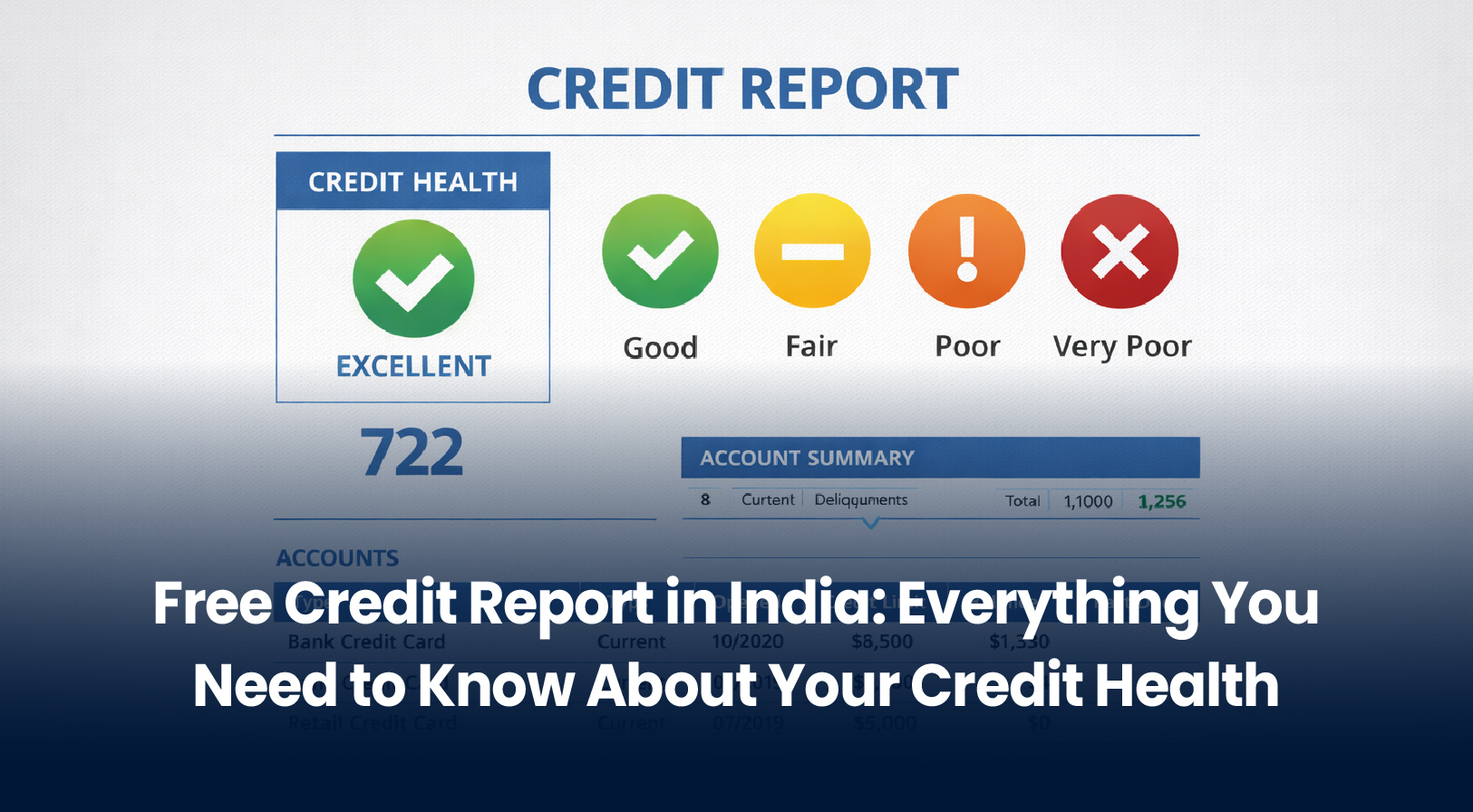
TL;DR: A credit report is your financial history document showing all loans, credit cards, payment history, and inquiries. Created by 4 Indian bureaus: CIBIL, CRIF, Equifax, Experian. It’s NOT your credit score (that’s a separate number). Free to check once yearly. Understanding your report helps you improve credit and get better loan rates.
One-Sentence Definition
A credit report is a detailed record of your credit history compiled by bureaus, showing all your loans, cards, payments, and inquiries.
That’s it. Now let me explain what that means.
Credit Report vs Credit Score: Critical Difference
Most people confuse these two. They’re NOT the same:
Credit Report:
- Document (detailed, multi-page)
- Your complete history
- Free once/year
- Shows WHY you’re creditworthy
Credit Score:
- Number (300-900)
- Summary only
- Usually paid (₹99-299)
- Shows HOW creditworthy you are
Think of it this way: Report = the book. Score = the rating on the back.
What’s Inside Your Credit Report? (5 Sections)
Section 1: Personal Information
Your name, date of birth, PAN, address, phone number, email. This helps lenders verify it’s really you.
Check for: Spelling errors, old addresses still listed, multiple names.
Section 2: Account Information
Every loan and credit card you’ve had, active or closed.
For each account, you see:
- Type: Personal loan, home loan, car loan, credit card
- When opened and closed
- Credit limit or loan amount
- Outstanding balance (how much you still owe)
- Payment status (current, overdue, closed)
Example: Your ₹5 lakh personal loan from SBI opened March 2023, currently ₹3 lakh remaining.
Section 3: Payment History (Most Important!)
Shows how you paid each account over 36 months. This heavily influences your credit score.
You see:
- Monthly repayment records (on time or late)
- Days overdue if you missed payments
- Amount paid vs amount due
One late payment can drop your score 20-50 points. Consistent on-time payments build trust.
Section 4: Credit Inquiries
Shows when lenders checked your report (when you applied for loans/cards).
Two types:
- Hard inquiries (from loan applications) = visible, slight score impact
- Soft inquiries (you checking) = invisible, no impact
Too many hard inquiries in short time signals desperation → red flag for lenders.
Section 5: Collections & Defaults
Shows unpaid accounts that went to debt collectors, defaults (3+ months unpaid), settlements where you paid less than owed.
These are serious red flags for lenders.
Read More: Credit Score vs CIBIL Score: Complete Guide
India’s 4 Credit Bureaus: Which Report Matters?
1. CIBIL (TransUnion CIBIL)
- Most important in India (80%+ of lenders use CIBIL scores)
- Oldest and largest database
- Your CIBIL report is most critical for loan approvals
2. CRIF High Mark
- Growing presence in India
- Used by many lenders (especially auto/personal loans)
- You should monitor CRIF score too
- Often has different data than CIBIL (not all lenders report to CRIF)
3. Equifax
- International reputation
- Increasingly used in India
- Different database = potentially different report
4. Experian
- Newest in India
- Comprehensive data collection
- Growing lender adoption
Bottom line: Check all 4 if possible. CIBIL matters most, but lenders may check multiple bureaus.
What Information Do Bureaus Collect?
Banks and financial institutions report to bureaus every 15 days (RBI mandate). They share:
- Your repayment history
- Loan amounts and status
- Credit card balances
- Application details
- Payment performance (on time or late)
What they DON’T collect:
- Your income
- Your job
- Your spending habits (except credit card usage)
- Personal data unrelated to credit
What is a “Good” Credit Report?
A good report shows:
- On-time payment history (36-month track record)
- Low credit utilization (<30% of credit card limits)
- Diverse credit types (loans + cards, not just one type)
- Few inquiries (1-2 per year is normal)
- No defaults or collections (most critical)
- No duplicate entries or errors
You don’t need perfection. Even one late payment is recoverable. Focus on consistent on-time payments for 6-12 months, dramatic improvements happen.
Common Credit Report Myths (BUSTED)
Myth 1: “Checking My Credit Report Will Hurt My Score”
FALSE. When YOU check your own report, it’s a soft inquiry. No impact. Only hard inquiries (from lenders) slightly affect scores. Check as often as you want.
Myth 2: “My Credit Report is the Same at All Bureaus”
FALSE. Each bureau has independent databases. CIBIL may have different info than CRIF. Lenders report to bureaus they work with. This is why checking all 4 is smart.
Myth 3: “I Only Need CIBIL; Other Bureaus Don’t Matter”
MISLEADING. CIBIL matters most (80%+ of lenders), but increasingly lenders check multiple bureaus. Having a good report across all 4 is safer.
Myth 4: “Errors in My Report Don’t Matter Much”
FALSE. Errors can tank your score. Wrong loan listed as yours? Late payment you actually paid on time? These need immediate correction.
Myth 5: “Once I Have a Bad Report, It’s Permanent”
FALSE. Credit history isn’t permanent. Negative items age out:
- Late payments: Visibility drops after 7 years
- Defaults: Impact decreases significantly after 3-5 years
- Collections: Can be resolved through disputes or settlement
How Credit Report Affects Your Life
Loan Approvals
Lenders check your report to decide: approve or reject?
Generally:
- Clean report = Easy approval
- Some issues = Difficult approval
- Major defaults = Rejection
Interest Rates
Same loan, different rates based on report quality.
Example:
- Good report: Personal loan at 9%
- Fair report: Personal loan at 14%
- Poor report: Personal loan at 18%+
Difference of ₹5 lakh over 5 years? Up to ₹1.5+ lakh in extra interest.
Loan Amount
Your report determines how much lenders will lend you.
Example:
- Good report: Approved for ₹10 lakh
- Fair report: Approved for ₹5 lakh
- Poor report: Approved for ₹2 lakh (or rejected)
Credit Card Eligibility
Credit cards are harder to get with poor reports. Limits are also lower.
Insurance & Rental
Increasingly, insurance companies and landlords check credit reports. Poor reports may mean higher deposits or rejections.
How Often Should You Check Your Report?
Legally: You’re entitled to one free report/year from each bureau.
Practically: Check every 6 months (free or low-cost options available).
Smart approach:
- Check all 4 bureaus once yearly (rotate: Jan-CIBIL, Apr-CRIF, Jul-Equifax, Oct-Experian)
- Before major loan applications (definitely check 2 weeks prior)
- If you suspect fraud (check immediately)
- After closing a loan or card
Most important: Check at least once yearly. Better proactive than reactive.
What to Do If You Find Errors
Step 1: Note the error (wrong account listed, wrong balance, payment marked late when you paid on time, duplicate entry).
Step 2: Contact the bureau directly:
- CIBIL: www.cibil.com
- CRIF: www.crif.in
- Equifax/Experian: Official websites
and, Step 3: File a formal dispute with evidence (payment receipts, loan statements).
Step 4: Bureau investigates (usually 30-45 days).
Step 5: Error is corrected or you get an explanation.
Timeline: The entire process can take 45-60 days, but once corrected, your score may improve 20-50 points.
FAQ
Q: Can I improve my credit report?
A: Yes. Consistent on-time payments for 6-12 months significantly improves it. Older negative items age out. Disputes for errors help. Credit rebuilding is possible.
Q: What if I’ve never borrowed money?
A: You likely have no report (no credit history). To build credit, take small loans, use a credit card responsibly, and pay on time. Building credit takes 6-12 months.
Q: Is my credit report public?
A: No. It’s confidential. Only authorized parties (lenders, employers with permission, landlords with permission) can access it.
Q: What’s the difference between a soft and hard inquiry?
A: Hard inquiry (from loan applications) shows on your report and slightly affects score. Soft inquiry (you checking) is invisible and has no impact.
Next Steps
If your report is clean: Maintain good habits, on-time payments, low utilization, avoid unnecessary applications.
If your report has issues: Dispute errors immediately, focus on on-time payments, reduce credit card balances.Either way: Check your free CIBIL score and report on CreditMitra. Takes 2 minutes, 100% free. No impact on your score.
About the Author

Divya Kumari
SEO Strategist & Finance WriterDivya Kumari is an SEO & Content Strategist with experience in organic traffic growth, topical authority building, and content-led SEO strategies. She specializes in creating user-focused content for finance and SaaS websites, helping brands improve visibility through structured content planning, internal linking, and search optimization techniques.
Borrow. Protect. Grow.
All in one app.
- Compare loan offers
- Buy insurance in minutes
- Invest in mutual funds
- Check credit score free
- Track all your applications


Explore More Articles

What to Do When Your Travel Budget Falls Short

How to Finance Your Dream Vacation Responsibly
On this page
- One-Sentence Definition
- Credit Report vs Credit Score: Critical Difference
- What's Inside Your Credit Report? (5 Sections)
- India's 4 Credit Bureaus: Which Report Matters?
- What Information Do Bureaus Collect?
- What is a “Good” Credit Report?
- Common Credit Report Myths (BUSTED)
- How Credit Report Affects Your Life
- How Often Should You Check Your Report?
- What to Do If You Find Errors
- FAQ
- Next Steps
About the Author
Divya Kumari
SEO Strategist & Finance WriterDivya Kumari is an SEO & Content Strategist with experience in organic traffic growth, topical authority building, and content-led SEO strategies. She specializes in creating user-focused content for finance and SaaS websites, helping brands improve visibility through structured content planning, internal linking, and search optimization techniques.
Borrow. Protect. Grow.
All in one app.
- Compare loan offers
- Buy insurance in minutes
- Invest in mutual funds
- Check credit score free
- Track all your applications