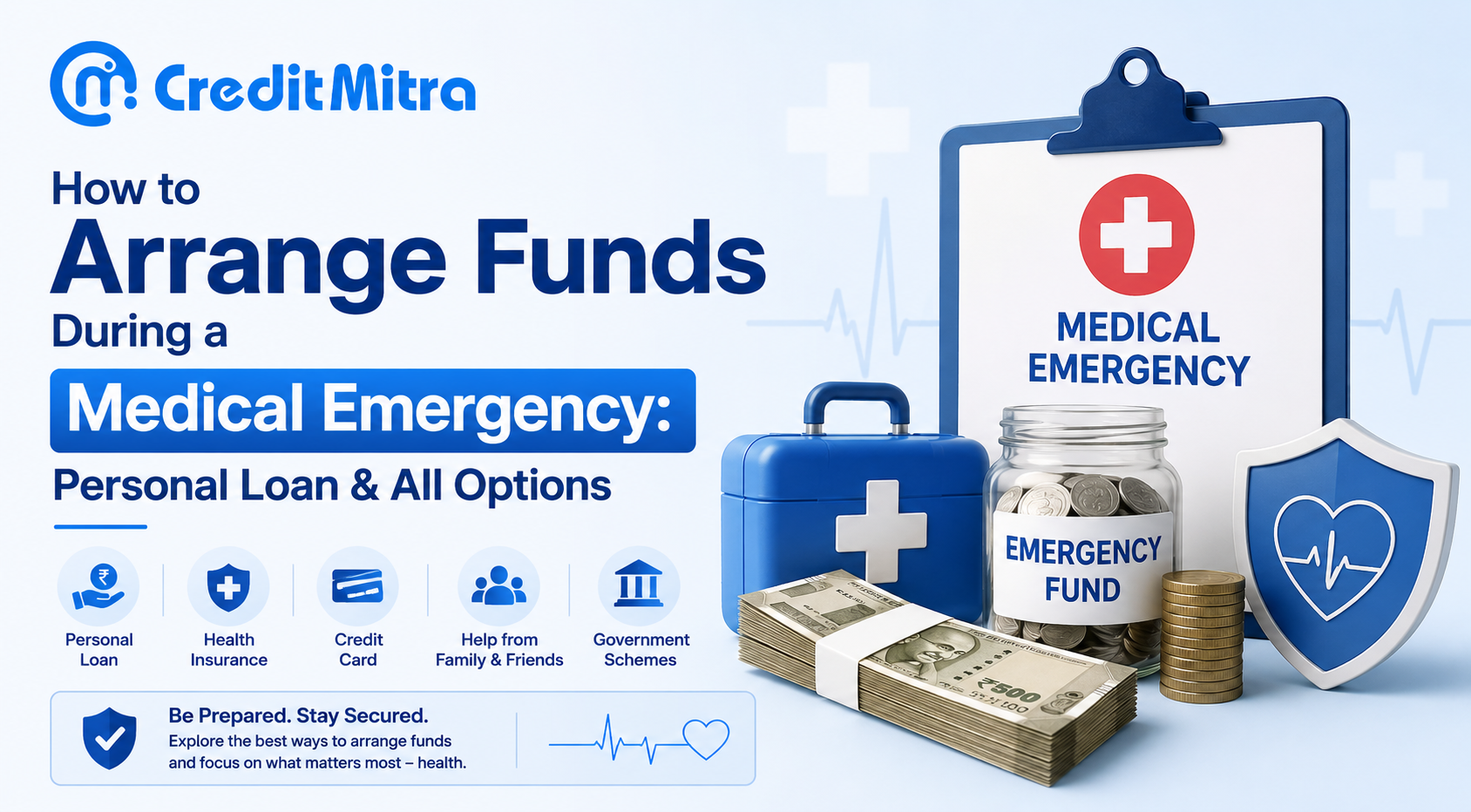
How to Arrange Funds During a Medical Emergency: Personal Loan & All Options
A medical emergency can create unexpected financial pressure when funds are needed quickly. Learn how to arrange funds for medical expenses, explore a personal loan for medical emergency needs, and understand eligibility, documents, application steps and other funding options.

It's 11 PM. Your father is in the ICU.
The hospital administrator asks for ₹2 lakh advance before surgery can begin.
Your health insurance covers ₹1 lakh. Your savings account has ₹40,000. You have exactly 6 hours.
This is the reality thousands of Indian families face every year. In India, nearly 47% of healthcare expenses are borne out-of-pocket by households, making medical emergencies one of the biggest financial stressors for families.
You don't have time to visit a bank, collect documents, or wait 5 days for approval. You need funds now—and there are reliable ways to get them.
Why Medical Emergencies Create Financial Crises
In 2026, the average cost of hospitalisation in private hospitals ranges between ₹50,000 to ₹2 lakh depending on the treatment. While health insurance and mediclaim policies provide some relief, many expenses such as consumables, post-surgery care or uncovered treatments still need to be managed.
What insurance typically doesn't cover:
Pre-hospitalisation diagnostic tests
Post-surgery recovery care at home
Experimental treatments
Consumables (gloves, syringes, PPE)
Non-network hospital cashless denial
Waiting period exclusions
Common medical costs in 2026:
The gap between what insurance pays and what hospitals charge is where families scramble.
Read More: How to Get Personal Loans
Your 6 Options for Emergency Medical Funds
Option 1: Hospital's Own Payment Schemes (Fastest—Zero Cost)
Before borrowing anything, ask the hospital directly.
Many hospitals—especially large chains (Apollo, Fortis, Max, Manipal)—offer:
EMI on treatment: Partner with banks/NBFCs to offer 0% EMI for up to 12 months
Deferred payment: Start treatment now, pay within 30-60 days
Trust funds: Some hospitals have patient welfare funds for underprivileged patients
Ask specifically: "Do you have a medical EMI scheme or deferred payment option?"
This costs you nothing extra. Most families never ask because they don't know it exists.
Option 2: Instant Personal Loan (Best Balance of Speed + Cost)
A medical emergency personal loan is a type of unsecured personal loan designed to cover urgent medical expenses such as hospitalisation, surgery, or treatment costs. Unlike traditional loans, these loans are processed quickly and usually do not require collateral. Borrowers can apply online and receive funds within a short time.
Emergency personal loans can be disbursed within minutes to a few hours or days after approval, depending on the lender and the verification process. IDFC FIRST Bank's FIRSTmoney loan makes the process even faster. You can get your loan amount in just 10 minutes.
Why personal loan beats other options for medical emergencies:
No collateral required (nothing to pledge in a crisis)
Funds directly to your bank account (hospital can then be paid)
Fixed EMI—predictable repayment once crisis is over
Available up to ₹5 lakh (covers most hospitalisation gaps)
Application takes 5 minutes on phone
CreditMitra offers instant personal loans up to ₹5 lakh—100% digital, minimal documentation, approval in minutes. When your family member is in the hospital, you don't have time for branch visits.
Option 3: Pre-Approved Loan (If You Qualify—Truly Instant)
If you're an existing customer of HDFC, ICICI, SBI, or Axis, check your net banking right now.
HDFC Bank provides instant personal loans specifically for medical emergencies. Existing customers with good credit history qualify for pre-approved loans. Loan amounts up to forty lakh rupees available based on eligibility.
Pre-approved loans in net banking are disbursed in 30 seconds to 2 minutes—no documentation, no verification, because the bank already has everything. This is the fastest legitimate option if it exists for you.
How to check:
HDFC: Log in → "Offers" → "Pre-Approved Loan"
ICICI: iMobile → "Pre-Approved Personal Loan"
SBI: YONO app → "Pre-Approved Loan"
Axis: Mobile banking → "My Offers"
Option 4: Credit Card (For Smaller Amounts—Quick But Expensive)
Credit cards are useful for smaller, immediate payments, but can become expensive if not paid off quickly due to high interest rates.
Use credit card for: Medicines, diagnostic tests, smaller hospital deposits (under ₹30,000)
Avoid credit cards: Large medical bills you can't clear within 45 days. Interest rate 36-42% p.a. will compound into a second crisis.
Better alternative: If you're carrying a credit card balance from medical expenses, a personal loan at 11.5% can clear it—saving significantly compared to 36% credit card interest.
Option 5: Gold Loan (Good If You Have Gold Immediately Available)
Pledge gold jewellery → get 75-85% of gold value instantly
Rate: 8-12% (cheaper than personal loan)
Process: 30-60 minutes at bank branch or Muthoot/Manappuram
Problem: Requires physically going to branch with gold jewellery—difficult during a medical crisis when you're at hospital.
Good for: When a family member can go to a gold lender while you stay at the hospital.
Option 6: Medical Crowdfunding (For Large Amounts—Last Resort)
Platforms: Milaap, Ketto, ImpactGuru
For: Cancer treatment, organ transplants, extremely expensive procedures (>₹10 lakh)
Reality: Takes days to set up, weeks to raise. Not suitable for immediate hospital advance payment. Better for longer treatment journeys.
How to Raise a Personal Loan for Medical Emergency: Step-by-Step
Research Options: Compare banks and NBFCs. Check Eligibility: Ensure income and credit score requirements are met. Gather Documents: Salary slips, ID proof and bank statements. Apply Online/Offline: Fill out the application form. Verification: Lender verifies employment and credit score. Approval & Disbursal: Loan amount credited within 24-48 hours.
Optimised for emergency speed:
Step 1: Determine exact amount needed (10 minutes)
Ask hospital for written estimate of total treatment cost
Check your insurance coverage letter
Calculate gap: Treatment cost - Insurance coverage - Available savings = Loan amount needed
Step 2: Check for pre-approved offers first (5 minutes)
Log into all your bank apps
Look for "Pre-approved loan" or "Instant loan" offers
If found: Apply immediately (30 seconds to 2 minutes disbursement)
Step 3: Apply to CreditMitra if no pre-approval exists (10 minutes)
Visit creditmitra.in on your phone
Enter basic details (income, PAN, Aadhaar)
Get instant approval for up to ₹5 lakh
Funds in account within minutes
Step 4: Documents to keep ready (always—not just during emergency)
PAN card (photo on phone)
Aadhaar card (DigiLocker copy acceptable)
Last 3 months salary slips
Last 6 months bank statements (downloadable from net banking instantly)
Total time from decision to funds: 20-45 minutes with digital lenders.
Read More: NBFC vs Bank Personal Loans
Eligibility for Medical Emergency Personal Loan
For a FIRSTmoney personal loan, both salaried as well as self-employed individuals between 21 and 60 years of age are eligible to apply. Moreover, you need to have a stable monthly income and a CIBIL score of 710 and above.
Standard eligibility:
What if CIBIL is low in an emergency?
Fintech lenders (KreditBee, Fibe, Moneyview) approve with CIBIL as low as 500-600—at higher rates (18-28%). In an emergency, a higher rate is acceptable. Refinance to lower rate after crisis resolves.
Interest Rates for Medical Emergency Loans (2026)
As of June 2026, HDFC Bank and ICICI Bank offer personal loans starting at 9.99% p.a. for pre-approved customers with CIBIL scores above 750.
Medical emergency loan rates by lender type:
EMI examples: ₹2 lakh medical loan at 14% p.a.
Recommendation: Choose 12-18 months for medical emergency loans. Medical debt shouldn't follow you for 5 years.
What Medical Expenses Can the Loan Cover?
Emergency medical loans can be used for hospital bills, surgeries, medicines, diagnostic tests, and post-treatment recovery expenses.
Complete list of covered expenses:
Hospital admission advance
Surgery and operation theatre charges
ICU and critical care charges
Medicines and consumables
Diagnostic tests (MRI, CT scan, blood tests)
Post-surgery rehabilitation
Home care nursing services
Medical equipment rental (oxygen concentrator, wheelchair)
Ambulance and transport
Second opinion medical consultation
One crucial tip: Include all expected medical costs in the loan amount from day one. Borrowing ₹1 lakh, then needing another ₹50,000 mid-treatment means a second application, second hard inquiry, and delay. Calculate total anticipated cost and borrow once.
Build Emergency Preparedness (Before the Next Crisis)
The best medical emergency loan is the one you never need.
3-part emergency preparedness plan:
1. Emergency fund (₹50,000-₹1 lakh in liquid savings) Keep in FD with overdraft facility or liquid mutual fund. Earns interest. Accessible within 24 hours.
2. Comprehensive health insurance Family floater policy covering ₹10-25 lakh. Premium: ₹15,000-₹35,000 annually. Far cheaper than borrowing.
3. Pre-approved loan limit standing by Check your net banking monthly. Know your pre-approved limit. In an emergency, one click disburses funds.
Cost of not being prepared:
₹2 lakh medical loan at 18% for 18 months = ₹30,924 interest
Health insurance premium covering this scenario: ₹20,000/year
Insurance saves ₹10,924 in this single event—and covers unlimited events.
FAQ: Personal Loan for Medical Emergency
Q: How fast can I get a personal loan for a medical emergency?
A: PayMe guarantees the availability of money in a few minutes, thus enabling families to concentrate on medical care and healing rather than being anxious about urgent hospital bills. Pre-approved loans from your existing bank: 30 seconds to 2 minutes. Digital lenders including CreditMitra: 10-30 minutes. Traditional banks: 2-24 hours.
Q: Can I get a medical emergency loan without a salary slip?
A: Basic KYC documents like PAN, Aadhaar, address proof, income proof, and bank details are required. All submissions are digital. Some fintech lenders accept bank statements instead of salary slips for self-employed applicants.
Q: What if my CIBIL score is low during an emergency?
A: Apply to fintech lenders (KreditBee, Fibe) who accept CIBIL 600+. Rates will be higher (18-28%) but funds available in 30 minutes. Refinance to lower-rate loan after crisis resolves.
Q: Can I use the loan for someone else's medical treatment?
A: Yes. Personal loans are disbursed to your account—you control how funds are used. You can pay any hospital bill, for any family member.
Q: Will taking an emergency medical loan hurt my CIBIL?
A: Avoid multiple loan inquiries in quick succession, as each hard inquiry can temporarily lower your score. Apply to one lender only. One hard inquiry drops score 5-10 points temporarily. On-time EMI repayment rebuilds score within 6 months.
Q: Is there any medical-specific loan with better terms?
A: Some hospitals partner with NBFCs for 0% interest medical EMI at point of treatment. Always ask the hospital first. If not available, standard personal loan at 10.5-14% is the next best option.
Conclusion: Fast Funds, Clear Plan, No Panic
A medical emergency is already the most stressful event a family faces. Financial uncertainty makes it worse.
Your emergency action sequence:
Ask hospital about EMI scheme/deferred payment (free, ask first)
Check net banking for pre-approved loan (30 seconds, instant funds)
Apply to CreditMitra for up to ₹5 lakh (minutes, fully digital)
Use credit card only for small amounts you can clear immediately
Consider gold loan if family member can visit lender while you're at hospital
After the crisis: Build the three-part preparedness plan so this never happens unprepared again.
Medical emergencies test families. Your financial response shouldn't add to the test.
Apply at creditmitra.in, instant personal loans up to ₹5 lakh, approved in minutes.
About the Author

Divya Kumari
SEO Strategist & Finance WriterDivya Kumari is an SEO & Content Strategist with experience in organic traffic growth, topical authority building, and content-led SEO strategies. She specializes in creating user-focused content for finance and SaaS websites, helping brands improve visibility through structured content planning, internal linking, and search optimization techniques.
Borrow. Protect. Grow.
All in one app.
- Compare loan offers
- Buy insurance in minutes
- Invest in mutual funds
- Check credit score free
- Track all your applications


Explore More Articles

What to Do When Your Travel Budget Falls Short

How to Finance Your Dream Vacation Responsibly
On this page
- Why Medical Emergencies Create Financial Crises
- Your 6 Options for Emergency Medical Funds
- How to Raise a Personal Loan for Medical Emergency: Step-by-Step
- Eligibility for Medical Emergency Personal Loan
- Interest Rates for Medical Emergency Loans (2026)
- What Medical Expenses Can the Loan Cover?
- Build Emergency Preparedness (Before the Next Crisis)
- FAQ: Personal Loan for Medical Emergency
- Conclusion: Fast Funds, Clear Plan, No Panic
About the Author
Divya Kumari
SEO Strategist & Finance WriterDivya Kumari is an SEO & Content Strategist with experience in organic traffic growth, topical authority building, and content-led SEO strategies. She specializes in creating user-focused content for finance and SaaS websites, helping brands improve visibility through structured content planning, internal linking, and search optimization techniques.
Borrow. Protect. Grow.
All in one app.
- Compare loan offers
- Buy insurance in minutes
- Invest in mutual funds
- Check credit score free
- Track all your applications