NBFC vs Bank: Complete Comparison 2026
Confused between NBFCs and banks for loans? This guide explains the difference between NBFC vs bank, including approval speed, documentation, interest rates, eligibility, and which option may suit different borrowers better.

You need ₹5 lakh for a home renovation. You approach your bank. They reject you because your CIBIL is 680. You’re frustrated.
Then an NBFC approves you the same day at 18% interest.
Now you’re confused. Is this a good deal? Is the NBFC safe? Why is the rate so high? Should you take it or wait for the bank?
This is the eternal dilemma: NBFC vs Bank. Here’s the complete comparison to help you decide.
Quick Answer: NBFC vs Bank
Banks: Lower rates (10-14%), longer approval (7-15 days), stricter eligibility (CIBIL 700+)
NBFCs: Higher rates (15-26%), faster approval (24-72 hours), flexible eligibility (CIBIL 600+)
Which is better? Depends on your situation.
What is a Bank?
A bank is an RBI-licensed financial institution that accepts public deposits (savings accounts, current accounts, fixed deposits) and provides personal loans. Banks are heavily regulated under the Banking Regulation Act 1949.
Key characteristics:
- Accept deposits from public
- Offer savings/current accounts
- Provide loans and credit
- Highly regulated by RBI
- Deposit insurance up to ₹5 lakh (DICGC)
- Lower interest rates (10-14%)
- Slower approval process (7-15 days)
- Stricter eligibility criteria
What is an NBFC?
An NBFC (Non-Banking Financial Company) is an RBI-regulated financial institution that provides loans and credit but cannot accept demand deposits (savings/current accounts). NBFCs are registered under Companies Act 2013.
Key characteristics:
- Cannot accept public deposits
- Only provide loans, credit, investments
- RBI regulated but with more flexibility
- No deposit insurance protection
- Higher interest rates (15-26%)
- Faster approval (24-72 hours)
- Flexible eligibility criteria
Key Differences: Comparison Table
| Factor | Banks | NBFCs |
| Interest Rate | 10-14% | 15-26% |
| Approval Speed | 7-15 days | 24-72 hours |
| CIBIL Requirement | 700+ | 600+ |
| Documentation | Extensive | Minimal |
| Processing Fee | 0.5%-1.5% | 1%-3% |
| Loan Amount | ₹10K-₹55L | ₹10K-₹55L |
| Tenure | 12-60 months | 12-60 months |
| Regulation | Banking Act 1949 | Companies Act 2013 |
| Deposit Insurance | Yes (₹5L) | No |
| RBI Regulation | Strict | Moderate |
| Customer Service | Formal | Customer-centric |
| Digital Features | Good | Excellent |
Read More: How to Get a Personal Loan Approved Fast in India
Interest Rate Comparison
Banks: 10-14% p.a. (good CIBIL) NBFCs: 15-26% p.a. (flexible CIBIL)
Why the difference?
Banks have lower cost of capital (they accept deposits at lower rates), lower operational costs, and an established customer base. They can afford lower rates.
NBFCs have higher funding costs, accept riskier borrowers, and lend to people banks reject. They charge higher rates to offset risk.
Real example: ₹5 lakh loan, 3-year tenure:
- Bank at 12%: Total interest = ₹78,400
- NBFC at 18%: Total interest = ₹1,17,600
- Difference: ₹39,200 extra with NBFC
Approval Speed: Banks vs NBFCs
Banks: 7-15 days NBFCs: 24-72 hours
Why? Banks conduct thorough verification (employment checks, income verification, background checks) because they accept public deposits and need to ensure stability. NBFCs have digital-first processes and fewer regulatory requirements, enabling rapid approval.
When this matters:
- Medical emergency: NBFC wins (approve in 24 hours)
- Home renovation planned: Bank is fine (better rates worth waiting)
- Business crisis: NBFC wins (urgent funds matter)
Eligibility Criteria Comparison
Banks: Stricter
- CIBIL 700+ required
- Stable employment 2+ years
- Documented income (salary slips, ITR)
- Debt-to-income <40%
- Professional employment preferred
NBFCs: Flexible
- CIBIL 600+ acceptable
- Employment 1+ year
- Alternative income sources accepted
- Debt-to-income up to 50%
- Self-employed, freelancers, gig workers welcome
Real scenario: You earn ₹40K/month as freelancer, CIBIL 650, have 6 months history.
- Bank: Likely rejection (self-employed, weak history, low CIBIL)
- NBFC: Likely approval at 20% interest
Documentation Comparison
Banks: Extensive
- Aadhaar, PAN, Passport
- Last 3 salary slips
- 2 years ITR
- Bank statements (12 months)
- Employment letter
- Address proof
- Tax returns
NBFCs: Minimal
- Aadhaar, PAN
- Last 1-2 salary slips
- Recent bank statements (3-6 months)
- Employment letter or self-employed proof
- Address proof
- Sometimes just digital documents
Time impact: Bank documentation takes days. NBFC documentation takes hours.
Read More: What is a Personal Loan? Complete 2026 Guide
Safety & Regulation
Are NBFCs safe?
Yes. Both banks and NBFCs are RBI-regulated. However:
- Banks: DICGC deposits insurance up to ₹5 lakh per depositor (protects your savings)
- NBFCs: No deposit insurance (but you’re borrowing, not depositing, so this doesn’t matter for loans)
For loan purposes, both are equally safe. NBFCs follow RBI rules on interest transparency, fair recovery practices, and customer data protection.
Real-World Scenarios: When to Choose Which
1: Excellent Credit, Can Wait CIBIL: 780, stable job 5+ years, need ₹5L in 2 weeks → Choose: Bank (10-12% rate saves ₹40K+ over 3 years)
2: Weak Credit, Urgent Need CIBIL: 620, self-employed, need ₹3L next week → Choose: NBFC (get approval in 24 hours, bank will reject)
3: Decent Credit, Moderate Urgency CIBIL: 700, salaried, need ₹2L in 5 days → Choose: Either (compare both rates, decide on total cost and timeline)
4: Multiple Rejections Applied to 3 banks, all rejected due to low CIBIL → Choose: NBFC (get approval where bank rejected)
Cost Comparison with Real Numbers
₹10 lakh loan, 5-year tenure:
Bank Option (CIBIL 750+):
- Interest rate: 12% p.a.
- Processing fee: 1% = ₹10,000
- Total interest: ₹2,61,100
- Total cost: ₹2,71,100
- Monthly EMI: ₹20,200
NBFC Option (CIBIL 650):
- Interest rate: 18% p.a.
- Processing fee: 2% = ₹20,000
- Total interest: ₹3,91,700
- Total cost: ₹4,11,700
- Monthly EMI: ₹20,300 (initially)
Difference: ₹1,40,600 extra cost with NBFC
But if the bank rejects you: NBFC ₹1,40,600 extra cost beats ₹0 (no loan).
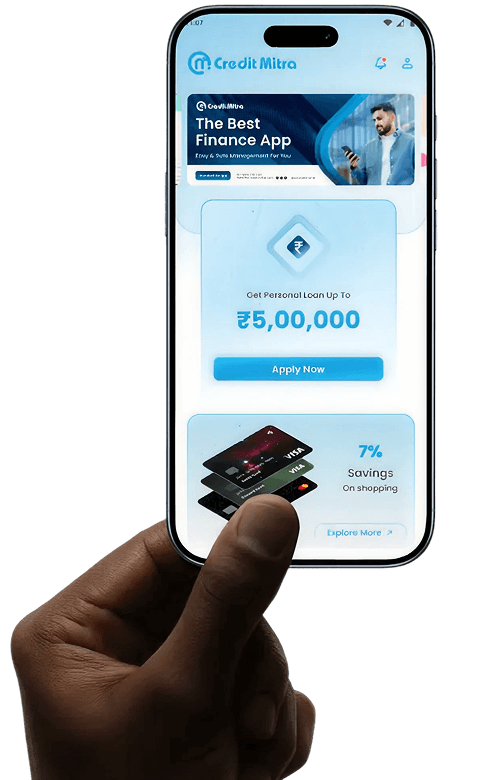
CreditMitra: Compare Both Simultaneously
Traditional method:
- Apply to bank (5-10 days wait)
- Bank rejects you
- Apply to NBFC (1-2 days wait)
- Multiple hard inquiries damage CIBIL
- No idea which was better option
CreditMitra method:
- Soft inquiry to both bank and NBFC simultaneously
- See both approval odds and rates
- Compare total cost
- Apply only to best option (one hard inquiry)
- CIBIL protected, informed decision
FAQ: Your Questions Answered
Q: Which is safer, bank or NBFC?
A: Both RBI-regulated and safe for loans. Banks have deposit insurance (doesn’t apply to you as a borrower). NBFCs are equally trustworthy if RBI-regulated.
Q: Can I switch from NBFC to bank later?
A: Yes. After 1-2 years of perfect NBFC payments, CIBIL improves, refinance with banks at lower rates.
Q: Will I get approved faster with NBFC?
A: Yes. 24-72 hours vs. bank 7-15 days. Major speed advantage.
Q: Is NBFC always more expensive?
A: Often yes, but sometimes no. If a bank rejects you, NBFC approval at any rate beats rejection.
Q: Can I negotiate rates?
A: Bank rates are somewhat flexible for good profiles. NBFC rates are less negotiable. Use CreditMitra to compare offers.
Q: What if I have bad credit?
A: The bank likely rejects you. NBFC approves at higher rates (18-26%). Improve CIBIL, refinance later.
Your Decision Framework
Choose Bank If:
- CIBIL 700+
- Stable employment 2+ years
- Can wait 7-15 days
- Priority is lowest rate
Choose NBFC If:
- CIBIL 600-699
- Self-employed or variable income
- Need funds urgently (within 72 hours)
- Bank rejected you
- Value speed over rate
The Real Answer: Use CreditMitra to compare both. See which approves you at what rate. Calculate total cost over tenure. Choose based on a complete picture, not just interest rate.
About the Author

Divya Kumari
SEO Strategist & Finance WriterDivya Kumari is an SEO & Content Strategist with experience in organic traffic growth, topical authority building, and content-led SEO strategies. She specializes in creating user-focused content for finance and SaaS websites, helping brands improve visibility through structured content planning, internal linking, and search optimization techniques.
Borrow. Protect. Grow.
All in one app.
- Compare loan offers
- Buy insurance in minutes
- Invest in mutual funds
- Check credit score free
- Track all your applications


Explore More Articles

What to Do When Your Travel Budget Falls Short

How to Finance Your Dream Vacation Responsibly
On this page
- Quick Answer: NBFC vs Bank
- What is a Bank?
- What is an NBFC?
- Key Differences: Comparison Table
- Interest Rate Comparison
- Approval Speed: Banks vs NBFCs
- Eligibility Criteria Comparison
- Documentation Comparison
- Safety & Regulation
- Real-World Scenarios: When to Choose Which
- Cost Comparison with Real Numbers
- CreditMitra: Compare Both Simultaneously
- FAQ: Your Questions Answered
- Your Decision Framework
About the Author
Divya Kumari
SEO Strategist & Finance WriterDivya Kumari is an SEO & Content Strategist with experience in organic traffic growth, topical authority building, and content-led SEO strategies. She specializes in creating user-focused content for finance and SaaS websites, helping brands improve visibility through structured content planning, internal linking, and search optimization techniques.
Borrow. Protect. Grow.
All in one app.
- Compare loan offers
- Buy insurance in minutes
- Invest in mutual funds
- Check credit score free
- Track all your applications