How EMI Payments Work on Bank Holidays
What happens if your EMI due date falls on a bank holiday? Learn how loan EMI payments are handled on holidays, Sundays and Saturdays, including auto-debit, ECS and NACH payments, and whether a holiday can affect your EMI deduction or payment status.

Your EMI due date falls on a public holiday. Your phone buzzes, nothing. You check your bank account, balance untouched. Panic sets in: Did I miss my EMI? Will there be a penalty? Will my CIBIL score drop?
The good news: you almost certainly have nothing to worry about. But "almost" is doing a lot of work in that sentence. This article explains exactly what happens to your EMI on a bank holiday, why it happens, and what you must do to make sure a simple calendar quirk never becomes a real financial problem.
What Is a Bank Holiday in India?
A bank holiday is any day on which bank branches are closed and core banking clearing systems do not run. In India, bank holidays are determined under the Negotiable Instruments Act, 1881 and fall into four categories:
Sundays are always non-banking days. The 1st and 3rd Saturdays of each month are regular working days. This Saturday distinction matters enormously for EMI dates, and it is something most articles on this topic get wrong.
How EMI Auto-Debit Actually Works, NACH Explained
Before answering what happens on a holiday, you need to understand how your EMI is collected in the first place.
What Is NACH? (And Why Most Articles Still Say ECS)
Most older articles, and even some bank websites, refer to EMI auto-debit as an ECS (Electronic Clearing System) transaction. ECS was the old system. Since 2016, NPCI (National Payments Corporation of India) has been progressively migrating all recurring mandates to NACH (National Automated Clearing House), and by 2022 NACH was the dominant system for EMI collections across home loans, personal loans, car loans, and other retail banking products.
The practical difference for borrowers is minimal, both work on the same principle. But understanding that the system is NACH helps you read your bank statement correctly and communicate accurately with your lender if something goes wrong.
How the NACH Debit Cycle Works
When you take a loan, your lender registers a NACH mandate with your bank. On each EMI due date, the lender submits a debit instruction to NPCI's NACH system. NPCI processes it in a batch run during banking hours, your bank debits the amount from your account, and the funds are transferred to the lender. This entire process is automated, no human intervention, no manual trigger.
Key point: NACH batch processing only runs on banking working days. If a holiday or Sunday falls on your due date, the system simply does not run that day, there is no debit attempt, and no failure to record.
What Happens When Your EMI Due Date Falls on a Bank Holiday?
Here is the definitive answer, stated plainly:
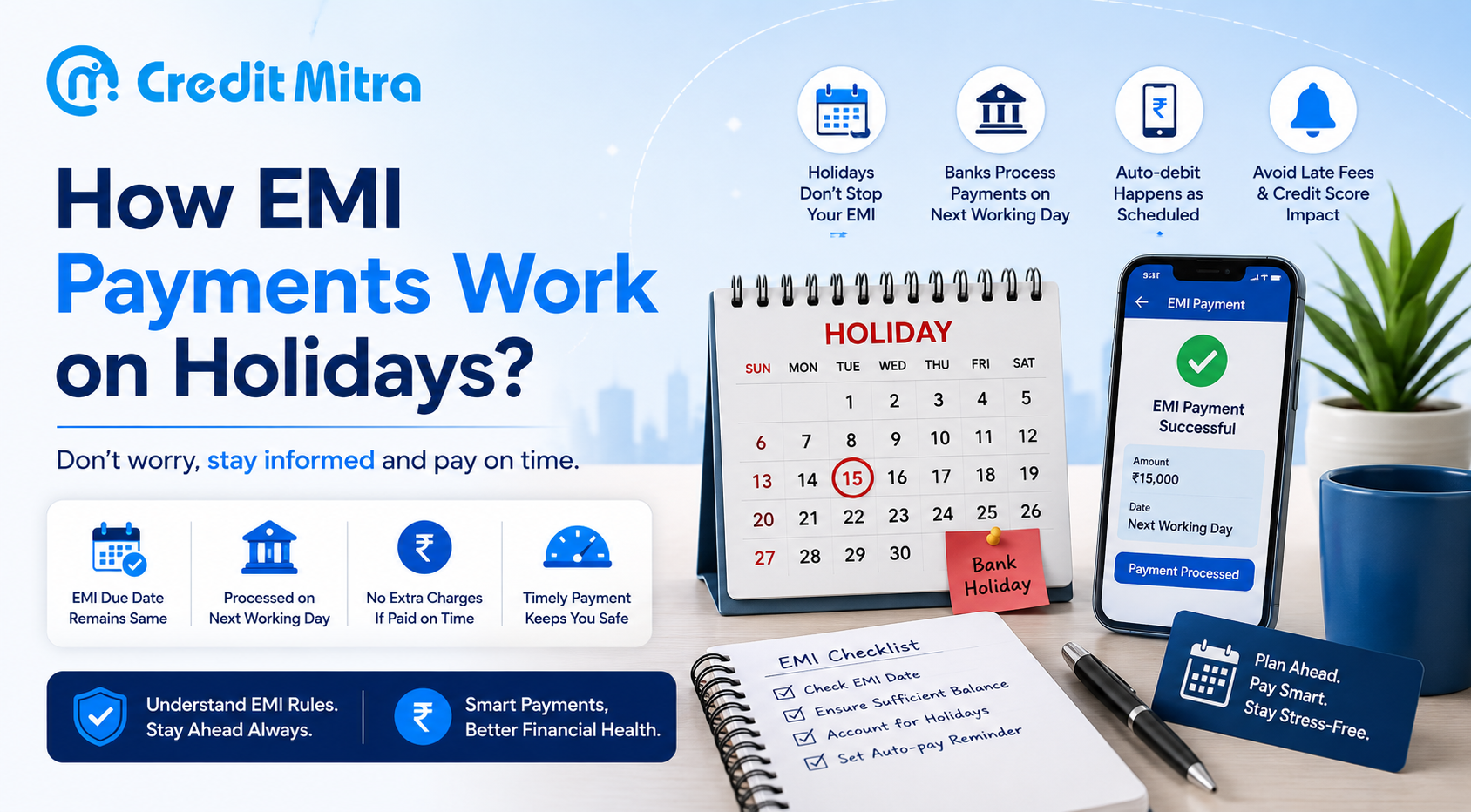
When an EMI due date falls on a bank holiday, the NACH debit does not process on that day. It is automatically deferred to the next banking working day. This is a system-level deferral, not a default, not a missed payment, and not a bounce.
The Rule: Next Working Day Processing
NPCI's NACH framework follows a clear rule: if a scheduled debit date falls on a holiday, it shifts to the immediate next working day. Lenders are fully aware of this mechanism, they build it into their system design. You do not need to call your bank, your lender, or do anything special. The system handles it automatically.
For example: if your EMI is due on 15 August (Independence Day), the debit will process on 16 August. If 16 August is also a holiday, it moves to 17 August, and so on until the next working day.
Does It Count as a Default or Missed Payment?
No. A deferral due to a bank holiday is not recorded as a missed EMI or a default in your loan account. Your lender's system logs this as a scheduled system deferral. Your payment history remains clean.
Will It Affect Your CIBIL Score?
A holiday deferral on its own: No CIBIL impact whatsoever.
However, here is where the real risk lies, and where most articles are dangerously silent:
The real risk: Insufficient funds on the next working day.
If the NACH debit is deferred to the next working day and your account does not have enough balance on that day, the debit will fail. That failed debit does count as a missed or bounced payment. After your lender's grace period (typically 3–7 days depending on your loan agreement), the missed payment is reported to TransUnion CIBIL. A single missed EMI can drop your CIBIL score by 50–100 points and stays on your credit report for 7 years.
The scenario that catches borrowers: They had money in the account on the original due date (the holiday). They assumed the debit had gone through. They spent some of that money over the holiday. The next working day, the debit runs on a lower balance, and bounces.
EMI on Sundays and Saturdays, Special Rules
EMI Payment on Sunday
Sundays are always non-banking days in India. Any EMI due on a Sunday will be deferred to Monday (the next working day). Keep your account funded through Monday morning.
EMI Payment on 2nd and 4th Saturday
The 2nd and 4th Saturday of every month are non-banking days by RBI directive, applicable to all scheduled banks nationwide. EMIs due on these Saturdays will move to the following Monday. If that Monday is also a holiday (rare but possible), it moves to Tuesday.
EMI Payment on 1st and 3rd Saturday
The 1st and 3rd Saturdays are regular banking working days. NACH processes normally on these days. Your EMI will be debited as scheduled, no deferral applies here.
Read More: Do Bank Holidays Affect Loan Approval and Disbursement in India?
Which Banking Services Work on Holidays?
This means you can always pay your EMI manually using UPI, NEFT, or IMPS on any holiday if you want peace of mind. Just be aware: if you pay manually and the NACH debit also runs the next working day, you could see a double debit. Check with your lender before doing this.
The 3-Step Holiday EMI Checklist
Do this before every upcoming holiday when your EMI date might be affected:
Step 1, Identify the holiday type. Is your EMI due date a national holiday, a state-specific gazetted holiday, a Sunday, or a 2nd/4th Saturday? Check the CreditMitra bank holiday calendar to confirm. Remember: 1st and 3rd Saturdays are working days, your EMI processes normally on those.
Step 2, Keep funds in your account from the day before. Some lenders pre-fetch or verify funds one day before the due date. Ensure the full EMI amount is in your linked account from the working day before the holiday, and keep it there through the next working day after the holiday.
Step 3, Don't move money between the holiday and the next working day. This is the most common mistake. The debit will run on the next working day, often a Monday after a long weekend. Do not transfer funds out or make large purchases between the holiday and that Monday morning.
What If Your EMI Bounces Anyway?
If the debit fails for any reason, including genuinely insufficient funds on the rescheduled day, here is what happens:
Your bank will levy a return or bounce charge (typically ₹300–₹750 + GST, depending on your bank)
Your lender may charge a late payment penalty (usually 2–3% per annum on the overdue amount, or a flat fee)
If not resolved within the lender's grace period (3–7 days typically), the missed payment is reported to TransUnion CIBIL
Once reported, it reflects in your credit report for 7 years and can reduce your score by 50–100+ points
If a bounce was genuinely due to a system error, not your lack of funds, raise a dispute immediately with your lender in writing. Request a correction letter to CIBIL. Banks are required to correct erroneous credit reporting under RBI guidelines.
Frequently Asked Questions
Q: Will my EMI be deducted on a bank holiday?
No. NACH-based EMI auto-debits are not processed on bank holidays, Sundays, or 2nd/4th Saturdays. The debit is automatically shifted to the next banking working day. No action is required from your side, just ensure sufficient funds remain in your account through that next working day.
Q: What happens if my EMI date falls on a Sunday?
Sundays are always non-banking days in India. If your EMI is due on a Sunday, the NACH debit will run on Monday (the next working day). Keep your account funded through Monday. If Monday is also a bank holiday, the debit moves to the next available working day.
Q: Does a holiday EMI deferral affect my CIBIL score?
The deferral itself does not affect your CIBIL score, it is a normal system event, not a default. However, if the re-attempted debit on the next working day fails due to insufficient funds, that is treated as a missed EMI and can be reported to CIBIL after the lender's grace period, potentially reducing your score by 50–100 points.
Q: Is EMI deducted on the 2nd and 4th Saturday?
No. The 2nd and 4th Saturday of every month are non-banking days per RBI's standing directive, applicable to all scheduled banks across India. EMIs due on these Saturdays are deferred to the following Monday. The 1st and 3rd Saturdays are regular working days, EMIs due on those processes normally.
Q: What is ECS payment on a bank holiday, is it different from NACH?
ECS (Electronic Clearing System) was the older system for recurring debit mandates, now largely replaced by NACH (National Automated Clearing House) operated by NPCI. Most loan EMIs since 2016 operate on NACH. The behaviour on holidays is the same, no processing on bank holidays, with the debit shifted to the next working day.
Q: Can I pay my EMI manually on a bank holiday?
Yes. UPI, NEFT, and IMPS all work 24/7 including on bank holidays. You can transfer the EMI amount to your lender's account manually. However, if your NACH mandate also runs on the next working day, you may see a double debit. Check with your lender first before making a manual payment.
About the Author

Divya
SEO Strategist & Finance WriterDivya Kumari is an SEO and Content Strategist with experience in organic traffic growth, topical authority building, and content-led SEO strategies. She specializes in creating user-focused content for finance and SaaS websites, helping brands improve visibility through structured content planning, internal linking, and search optimization techniques.
Borrow. Protect. Grow.
All in one app.
- Compare loan offers
- Buy insurance in minutes
- Invest in mutual funds
- Check credit score free
- Track all your applications


Explore More Articles

What to Do When Your Travel Budget Falls Short

How to Finance Your Dream Vacation Responsibly
About the Author
Divya
SEO Strategist & Finance WriterDivya Kumari is an SEO and Content Strategist with experience in organic traffic growth, topical authority building, and content-led SEO strategies. She specializes in creating user-focused content for finance and SaaS websites, helping brands improve visibility through structured content planning, internal linking, and search optimization techniques.
Borrow. Protect. Grow.
All in one app.
- Compare loan offers
- Buy insurance in minutes
- Invest in mutual funds
- Check credit score free
- Track all your applications