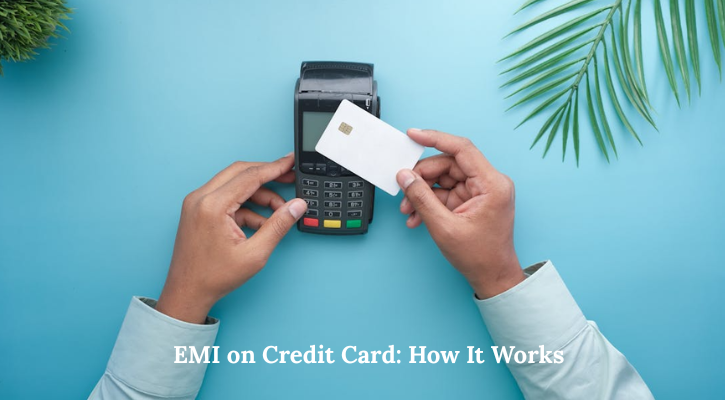
EMI on Credit Card: How It Works and When to Choose Personal Loan Instead
Credit card EMI allows you to convert large purchases into smaller monthly payments. This guide explains how credit card EMI works, eligibility, interest charges, repayment process, and how to use EMI options on your credit card effectively.

TL;DR: Credit card EMI allows you to divide your purchases into installments (interest: 12-24%). Processing fee: 2-4%. Zero interest EMI on selected products. Personal loans will be cheaper for big amounts (interest 8-15%). On ₹50,000: EMI from credit card ₹4,700 interest vs Personal loan ₹2,500 interest. Prefer credit card EMI for instant & small purchases; go for personal loan on ₹2L+. EMI stands for Equated Monthly Installment. It is the facility of converting your credit card purchases into EMIs instead of paying the entire amount upfront. Example: If you buy a ₹50,000 laptop, instead of paying ₹50,000 at one time you can convert it into monthly EMIs of ~₹4,250 (includes interest). Simple. This way you get a facility of making expensive purchases more manageable through EMIs for 3-48 months. Step 1: While purchasing something online or offline, check for "EMI" or "No Cost EMI" at the time of checkout. Step 2: Tick on "Yes, I want EMI" and select your preferred tenure (like 3, 6, 12 months etc.). Step 3: System shows your monthly installment amount. Step 4: Confirm and proceed with payment. That's all. Your purchase is now divided into monthly EMIs in the form of your credit card transactions. In case you forget to convert at the time of purchase: Step 1: Log into the app of your bank or Internet banking. Step 2: Click on the "Credit Card" tab → Look for "Convert to EMI" or "EMI on Call". Step 3: Select the transaction you want to convert. Step 4: Select your tenure (3-48 months depending on your bank). Step 5: Confirm. Within 5 minutes. Some banks provide "EMI on Call" through which you have to just give a call to the customer care for requesting conversion. It takes 5-10 mins. Read More: What is a Credit Report? Complete 2026 Guide Normally: 12-24% annually Varies according to: Bank, Type of Card, Your Credit Score, Tenure selected For instance: ₹50,000 at 18% for 12 months = ₹4,700 interest charge Normally: 2-4% of the principal For instance: ₹50,000 × 3% = ₹1,500 processing fee Can be: Charged either in the first installment or distributed over all EMIs Purchase: ₹50,000 Monthly EMI: ₹4,250 (Approximately) Your total payment amount would be ₹56,200 (not ₹50,000) No-Cost EMI facility is provided by some merchants/banks on particular products. In this case, you would make payments of principal amount only without any interest charges. Why? The merchant or bank pays the interest cost. Where is it available? Electronics (Mobile Phone, Laptop, Television) Appliances (Washing Machine, Refrigerator, Air Conditioner) Furniture Jewellery (Sometimes) Note that: It is not available on all products at all times Requires minimum purchase value (More than ₹10,000 usually) Available only on selected products during promotional periods Also not available on all cards If available, No-Cost EMI would be the best option. Read More: Credit Card Loan vs Personal Loan in India Which is cheaper? Credit Card EMI @ 18% + 3% fee: Interest: ₹4,700 Processing fee: ₹1,500 Total cost: ₹6,200 Personal Loan @ 10% + 1% fee: Interest: ₹2,500 Processing fee: ₹500 Total cost: ₹3,000 Savings with personal loan: ₹3,200 (50% cheaper!) No-cost EMI is available (truly free) Amount >₹1 lakh (credit card limit too small) Positive: Making timely EMI payments helps your score (positive payment history) Diverse credit types help score Negative: Increases credit utilization (portion of credit limit used) High utilization (>30%) can drop score 10-20 points Default on EMI drops score 100+ points Solution: If converting to EMI, monitor your total credit utilization. Ideally keep it below 30% by: Paying off other card balances Converting only if you have sufficient unused limit Making on-time payments consistently Credit Utilization: Ratio of credit used as compared to your credit limit. Example: In case your credit limit is ₹1L and the EMI is ₹30K, then utilization ratio will be 30%. Processing Charges: One time charges levied on conversion of your payment into EMI, usually between 2% - 4% of principal. Tenure: Period of time within which one has to repay the EMI amount. Tenure choices include 3, 6, 9, 12, 18 and 24 months (in some cases up to 48 months). Foreclosure: Repayment of the EMI before the due date. Foreclosure charges are levied by some banks at 1% to 3%. Revolving Credit: Your credit card is revolving in nature in the sense that, as you reduce the balance, your limit gets increased. Q: Does conversion of credit to EMI affect my credit score immediately? Q: Can I pay my EMI ahead of schedule? Q: Is there anything like a no-cost EMI? Q: What should I do if I cannot make the EMI?What is Credit Card EMI? (Definition Explained)
How Does EMI Work on Credit Cards? (Process Explained in Steps)
Method 1: Convert at the Time of Purchase (Online or In-Store)
Method 2: Convert After the Purchase (Within 30 Days)
Method 3: EMI on Call
What is the Cost of EMI on Your Credit Card?
Interest Rate
Processing Fee
Total Cost Calculation Example
Tenure: 12 Months
Interest Rate: 18%
Processing Fee: 3% = ₹1,500
Total Interest Charge: ₹4,700
Additional Charges Total: ₹4,700 + ₹1,500 = ₹6,200No-Cost EMI: When It's Really Free
Credit Card EMI vs Personal Loan: Cost Comparison
Real Cost Comparison: ₹50,000 Purchase, 12 Months
When to Use Credit Card EMI
Use Credit Card EMI If:
Unplanned purchase (need instant approval)
Small amount (₹5K-₹1L)
You want to preserve cash flow (immediate need)
Good credit score (get better rates)Use Personal Loan Instead If:
Want lowest cost (personal loans 8-15% vs credit card EMI 18-24%)
Need to preserve credit limit (EMI reduces it significantly)
Any purpose needed (credit card EMI only for purchases)
High credit utilization already (EMI will push it higher)Impact on Credit Score
How Credit Card EMI Affects Your Score
Important Terms to Know
Frequently Asked Questions
A: No, it does not. Though, it impacts the credit utilization rate. It lowers your score by 5 to 15 points when you exceed 30% utilization. Regular payments will improve your score.
A: Yes, many banks permit foreclosure. They levy foreclosure charges of 1% to 3%. Paying ahead of schedule reduces future interest payments. Do some calculations to see if savings are worth foreclosure charges.
A: For you, yes. Your merchant or bank bears the cost of interest. But, this facility is available on select items during promotional offers.
A: Contact your bank immediately about a payment holiday or restructuring facility. Avoid neglecting your payments. It becomes a default after 90 days and impacts your score.
About the Author

Divya Kumari
SEO Strategist & Finance WriterDivya Kumari is an SEO & Content Strategist with experience in organic traffic growth, topical authority building, and content-led SEO strategies. She specializes in creating user-focused content for finance and SaaS websites, helping brands improve visibility through structured content planning, internal linking, and search optimization techniques.
Borrow. Protect. Grow.
All in one app.
- Compare loan offers
- Buy insurance in minutes
- Invest in mutual funds
- Check credit score free
- Track all your applications


Explore More Articles
7 Days Loan App: Real Cost, Risks and Safer Options

What to Do When Your Travel Budget Falls Short
On this page
- What is Credit Card EMI? (Definition Explained)
- How Does EMI Work on Credit Cards? (Process Explained in Steps)
- What is the Cost of EMI on Your Credit Card?
- No-Cost EMI: When It's Really Free
- Credit Card EMI vs Personal Loan: Cost Comparison
- When to Use Credit Card EMI
- Impact on Credit Score
- Important Terms to Know
- Frequently Asked Questions
About the Author
Divya Kumari
SEO Strategist & Finance WriterDivya Kumari is an SEO & Content Strategist with experience in organic traffic growth, topical authority building, and content-led SEO strategies. She specializes in creating user-focused content for finance and SaaS websites, helping brands improve visibility through structured content planning, internal linking, and search optimization techniques.
Borrow. Protect. Grow.
All in one app.
- Compare loan offers
- Buy insurance in minutes
- Invest in mutual funds
- Check credit score free
- Track all your applications