Car Loan vs Personal Loan: Which Is Better for Buying? (2026)
Choosing between a car loan and a personal loan depends on your budget, interest rate, repayment flexibility, and financing needs. This guide compares car loan vs personal loan, covering interest rates, eligibility, loan tenure, collateral requirements, and the pros and cons of each option to help you make an informed borrowing decision.

You've finalized the car. Now comes the loan decision.
Car loan or personal loan? Most people assume the answer is obvious, car loans have lower interest rates, so they must be better. But that assumption has three blind spots: it ignores hidden charges, it breaks completely for used car purchases, and it overlooks an ownership factor that catches buyers by surprise at resale time.
This guide gives you the complete comparison, rates, true costs, the RC hypothecation factor, and a clear decision framework so you pick the right loan for your specific situation.
The Core Difference in One Line
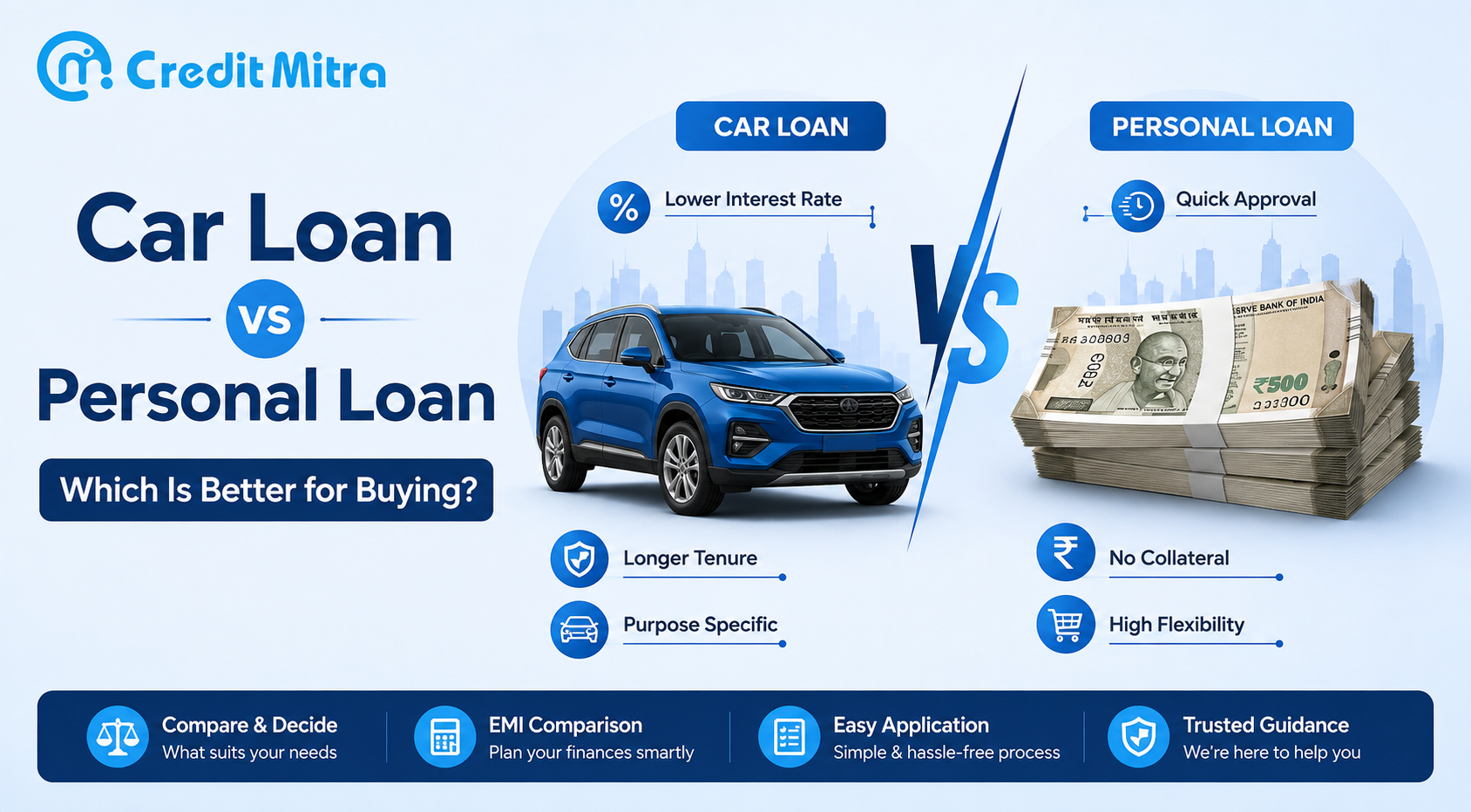
In a car loan, the vehicle you are purchasing acts as collateral. Secured loans usually have lower interest rates because the lender has a claim on your car if you fail to repay the loan. Personal loans are unsecured loans that can be used for any purpose, including vehicle purchase. They do not require collateral but depend heavily on creditworthiness and income.
That's the entire difference in two sentences. Everything else, rates, tenure, documentation, ownership, flows from this single distinction.
Car Loan vs Personal Loan: Side-by-Side Comparison
Interest Rates: Car Loan vs Personal Loan (2026)
New Car Loan Rates
Car loan interest rates across the market start from around 7.45 per cent depending on the borrower's profile and scheme. Punjab National Bank: 7.60–10.70 per cent; Bank of Baroda: 7.60–11.35 per cent; Canara Bank: 7.45–11.45 per cent; State Bank of India: 8.70–9.85 per cent; HDFC Bank: from 8.15 per cent; ICICI Bank: from 8.50 per cent.
For most salaried borrowers with CIBIL 750+, realistic new car loan rates in 2026 fall between 8.15%–9.5% p.a. at mainstream banks. The sub-8% rates are typically available only to select profiles at public sector banks.
Personal Loan Rates for Car Purchase
Personal loan rates in 2026 start from 9.99% p.a. (IDFC FIRST Bank, HDFC Bank for top-tier borrowers) and scale up to 15–18% for CIBIL scores in the 680–720 range. Borrowers with CIBIL below 680 face 18–24% rates.
CIBIL Score × Rate Band
The key insight: For borrowers with CIBIL 750+, the rate gap is 1.5–3%. For borrowers with CIBIL below 720, the gap widens to 3–5%. The lower your CIBIL, the more a car loan's secured nature helps.
Real Interest Cost: ₹7 Lakh Loan Over 5 Years
A borrower with CIBIL 750+ pays approximately ₹52,000 more in interest over 5 years choosing a personal loan over a car loan, before factoring in any hidden charges.
Read More: NOC Full Form: What Is NOC Certificate
The Hidden Costs Nobody Compares (True Total Cost)
The rate comparison above doesn't tell the whole story. Both loan types carry charges that affect total cost.
Car Loan Hidden Costs
Processing fee: 0.25%–1% of loan amount (₹1,750–₹7,000 on a ₹7L loan)
Hypothecation registration: ₹1,500–₹3,000 (for endorsing lender's charge on RC)
Comprehensive insurance requirement: Lenders typically require comprehensive insurance (not third-party only), adding ₹15,000–₹30,000/year for the first 3–5 years
Foreclosure charges: 2–6% of outstanding principal if you repay early
Personal Loan Hidden Costs
Processing fee: 1–3% of loan amount (₹7,000–₹21,000 on a ₹7L loan) + 18% GST
Prepayment penalty: 2–5% if you repay early (though some lenders waive this)
No insurance mandate, no hypothecation charge
True Total Cost (₹7L, 5 Years, CIBIL 750+)
The true cost gap is higher than the rate gap suggests, approximately ₹64,000 on a ₹7L loan over 5 years for CIBIL 750+ borrowers.
The RC Hypothecation Factor
Car loans are secured loans specifically designed for purchasing vehicles, where the car itself serves as collateral. This collateral relationship is recorded on your car's Registration Certificate (RC) as a hypothecation charge in the lender's name.
What this means in practice:
Your RC shows the lender's name alongside yours until the loan is fully repaid
You cannot sell the car easily without first clearing the loan and obtaining an NOC (No Objection Certificate) from the lender, a process that can take several days to weeks
Some buyers discover this when they try to upgrade to a newer car mid-loan and face complications
With a personal loan: The car's RC is clean from Day 1, issued in your name alone. No hypothecation, no NOC required. You can sell the car at any point without coordination with the lender.
This matters most for:
Buyers planning to sell within 3–5 years (before the loan would naturally be repaid)
Those who value complete ownership flexibility
Buyers considering using the car as security for another loan later
The Used Car Exception, When Personal Loan Often Wins
This is where the conventional wisdom completely breaks down.
If you are looking to purchase a pre-owned car, you can avail a bank loan for that as well. The only point to consider while purchasing a pre-owned vehicle on a bank loan is that the car should not be more than 3 years old.
Used car loan rates in India are significantly higher than new car loan rates:
Compare this to a personal loan for a CIBIL 750+ borrower at 10%–12% p.a.
The used car math:
For used car purchases, a personal loan from a good-CIBIL borrower can save ₹15,000–₹25,000 in interest AND provide:
No car age restriction (buy a 10-year-old car if you want)
Clean RC ownership
Faster disbursal
Ability to cover registration and insurance with same loan
When to Choose a Car Loan
Car loans are the better choice when:
Buying a new car with a significant down payment (20%+)
CIBIL is 750+ and you qualify for sub-9% rates
Tenure matters: You need 6–8 years to keep EMIs affordable (personal loans max at 7 years)
You're keeping the car long-term and won't need to sell before loan closure
Rate gap exceeds 3% between your car loan offer and personal loan offer
Budget is tight: The lower rate reduces your EMI meaningfully
When to Choose a Personal Loan
Personal loans are the better choice when:
Buying a used car above 5 years old (ineligible for most used car loans) OR where the used car loan rate makes personal loan competitive
You want clean RC ownership from Day 1 without hypothecation
Speed is critical: Closing a private seller deal where funds are needed in 24 hours
CIBIL is lower but an NBFC offers you a personal loan (vs. getting rejected for car loan)
Covering on-road costs: Registration, insurance, accessories, personal loan funds all of it; car loan typically doesn't
The rate gap is under 1.5% and hypothecation-free ownership matters to you
Planning to sell within 2–3 years before the loan period ends
The Decision Matrix
FAQ: Car Loan vs Personal Loan
Q: Is car loan interest rate lower than personal loan?
Yes, for new cars. New car loan rates in India start from 7.45% p.a. Most banks offer rates between 7.40%–9.00% for new cars. Personal loans start from 9.99% p.a. However, for used cars, the gap narrows significantly since used car loans carry 11–16% rates.
Q: Can I use a personal loan to buy a car in India?
Yes. Personal loans can be used for any purpose including car purchase. <cite index="16-1">Personal loans offer greater flexibility in their end use. You can use the money for other expenses, such as your vehicle's registration, insurance, and other non-vehicle-purchasing expenses.
Q: What is hypothecation in a car loan?
When you take a car loan, the lender places a hypothecation charge on your car's RC, meaning they have a legal claim on the vehicle until the loan is repaid. Selling the car requires an NOC from the lender. Personal loans carry no such charge; the RC is clean from Day 1.
Q: Which loan is better for a used car?
For used cars above 5 years old: personal loan is the only option (used car loans don't fund older cars). For used cars under 5 years: compare rates, used car loans at 11–16% may or may not be better than your personal loan offer at 10–14%, depending on your CIBIL score.
Q: Does CIBIL score matter more for car loans or personal loans?
CIBIL matters for both, but the impact is slightly different. For car loans, lower CIBIL still gets approved (car is collateral), but rates worsen. For personal loans, CIBIL below 650 may mean rejection. A 750+ CIBIL score gets you the best rates on both.
Q: Which loan is approved faster?
Personal loans are faster, typically 24–48 hours for digitally verified applicants. Car loans take 2–5 days due to vehicle documentation and hypothecation registration. If you're buying from a private seller with time pressure, personal loan is the practical choice.
The Bottom Line
For a new car purchase with CIBIL 750+, a car loan is almost certainly cheaper in total cost, save approximately ₹60,000–₹80,000 on a ₹7–10 lakh loan over 5 years compared to a personal loan.
For a used car, run the numbers before assuming: used car loans are 11–16%, which makes personal loans genuinely competitive, with the added benefit of no car age restriction and clean RC ownership.
For buyers who want clean ownership from Day 1, need funds urgently, or are funding a used car above 5 years, a personal loan from a good lender is often the smarter choice.
Before you decide: Compare personal loan rates from 20+ banks and NBFCs on CreditMitra, see your personalised rate based on your CIBIL score, income, and employer, without a single hard inquiry. Apply in 5 minutes; disbursal in 24 hours.
About the Author

Divya Kumari
SEO Strategist & Finance WriterDivya Kumari is an SEO & Content Strategist with experience in organic traffic growth, topical authority building, and content-led SEO strategies. She specializes in creating user-focused content for finance and SaaS websites, helping brands improve visibility through structured content planning, internal linking, and search optimization techniques.
Borrow. Protect. Grow.
All in one app.
- Compare loan offers
- Buy insurance in minutes
- Invest in mutual funds
- Check credit score free
- Track all your applications


Explore More Articles

What to Do When Your Travel Budget Falls Short

How to Finance Your Dream Vacation Responsibly
On this page
- The Core Difference in One Line
- Car Loan vs Personal Loan: Side-by-Side Comparison
- Interest Rates: Car Loan vs Personal Loan (2026)
- The Hidden Costs Nobody Compares (True Total Cost)
- The RC Hypothecation Factor
- The Used Car Exception, When Personal Loan Often Wins
- When to Choose a Car Loan
- When to Choose a Personal Loan
- The Decision Matrix
- FAQ: Car Loan vs Personal Loan
- The Bottom Line
About the Author
Divya Kumari
SEO Strategist & Finance WriterDivya Kumari is an SEO & Content Strategist with experience in organic traffic growth, topical authority building, and content-led SEO strategies. She specializes in creating user-focused content for finance and SaaS websites, helping brands improve visibility through structured content planning, internal linking, and search optimization techniques.
Borrow. Protect. Grow.
All in one app.
- Compare loan offers
- Buy insurance in minutes
- Invest in mutual funds
- Check credit score free
- Track all your applications