Can a Personal Loan Help You Pay Off Credit Card Debt?
A personal loan can be used to pay off credit card debt and may help consolidate multiple balances into a single repayment. Learn how it works, when it can make sense, eligibility requirements, benefits, risks, and alternatives to consider before using a personal loan to repay credit card debt.

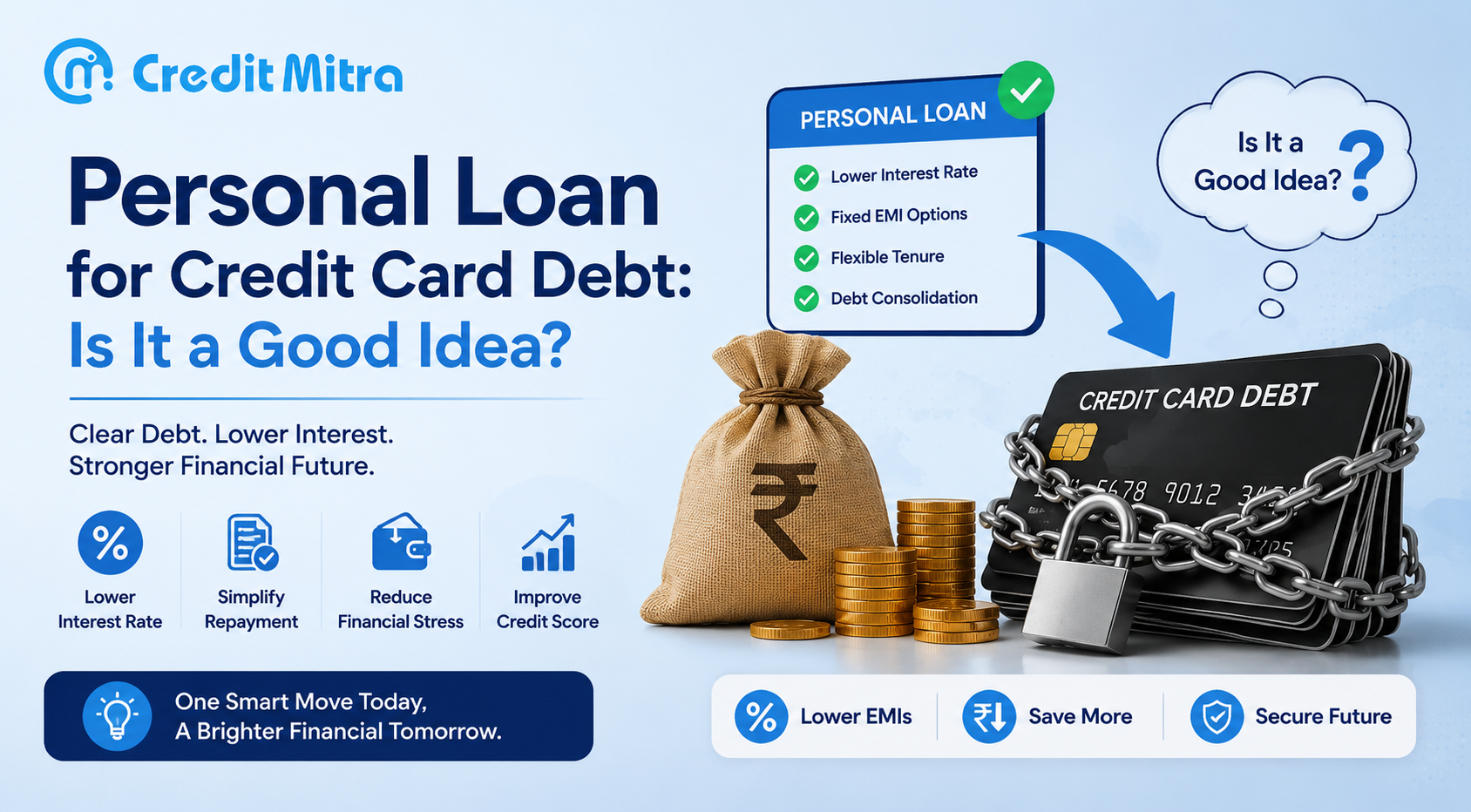
Your credit card bill arrives. You look at the outstanding balance, ₹1,20,000. You look at the minimum amount due, ₹3,600. You pay ₹3,600 and move on.
What you may not know: at 36% annual interest, that ₹1,20,000 balance will take over 5 years to clear on minimum payments. And you'll pay approximately ₹1,10,000 in interest alone, nearly doubling what you originally owed.
This is the minimum payment trap. Most credit card holders in India are in it without knowing it.
A personal loan can get you out of it, but not automatically. The maths need to work, your CIBIL needs to cooperate, and there's a behavioural risk that derails about 40% of people who try this. This article gives you the honest picture: when it works, when it doesn't, and exactly how much it saves.
The Core Problem: What Credit Card Debt Actually Costs You
Personal loans for prime borrowers start at roughly 10%–12%, whereas credit card revolving interest remains between 36% and 48%. If you cannot pay back the full amount within 45 days, a personal loan is nearly 4x cheaper.
Let that sink in. 4x cheaper.
Most people think of credit card interest in abstract terms. Here's what it looks like in concrete rupees on a ₹1 lakh balance.
The Minimum Payment Trap: Real Numbers
When you carry ₹1 lakh on a credit card charging 36% annual interest and make only minimum payments:
Notice what's happening: your minimum payment barely covers the interest. After 12 months, you've paid ₹35,000+ and still owe ₹96,100. Your debt has barely moved.
At this pace:
Time to clear ₹1L: 5–7 years (minimum payments only)
Total interest paid: ₹85,000–₹1,10,000
Total amount paid: ₹1,85,000–₹2,10,000 on a ₹1 lakh debt
Learn Everything About Debt Consolidation Loan
How a Personal Loan Changes the Maths
As of 2026, personal loan interest rates in India start from 9.98% p.a., owing to the repo rate being 5.25%, the lowest in the past 7 years.
Now let's put these two side by side.
Side-by-Side Comparison: ₹1 Lakh Debt Over 24 Months
The savings are enormous:
At 12% personal loan: save ₹97,000 in interest, clear debt 3–5 years sooner
At 15% personal loan: save ₹93,600 in interest, clear debt 3–4 years sooner
Yes, your monthly payment goes up (₹4,707 vs. ₹3,000 minimum). But you're paying off the actual principal. The credit card minimum payment was mostly interest. You were essentially treading water.
As of June 2026, HDFC Bank and ICICI Bank offer personal loans starting at 9.99% p.a. for pre-approved customers with CIBIL scores above 750. Most borrowers with a good but not exceptional profile see rates between 11%–16%.
Read More: Credit Card Loan vs Personal Loan in India
When Using a Personal Loan for Credit Card Debt Makes Sense
Condition 1: Your Personal Loan Rate Is Meaningfully Lower
The break-even isn't just "any rate lower than 36%." You need a gap big enough to justify the exercise, ideally 15% or more lower. At sub-14% personal loan rates (CIBIL 720+), the savings are compelling on any amount above ₹50K.
If your personal loan rate is 20%, you're still saving significantly vs. 36% credit card, but the calculation matters more at higher balances.
Condition 2: You Have Stable Income to Service the EMI
The personal loan EMI will be higher than your current minimum credit card payment. Confirm this fits comfortably within your FOIR (Fixed Obligation to Income Ratio), ideally keeping total EMIs below 40–50% of monthly income.
Condition 3: CIBIL Is 700 or Above
Each 50-point increase in CIBIL = approximately 1% rate reduction.
Below 650, personal loan rates often exceed 20%, and the savings case becomes weaker. If your CIBIL is low due to credit card debt, consider: pay down the card to 30% utilisation first (improving your score 20–50 points), then apply for the personal loan at a better rate.
Condition 4: You Have a Plan for the Freed Credit Card
The card's credit limit returns to zero the day you pay it off. If you don't have a plan for it, there's a very real risk of re-using it and ending up with both a personal loan EMI and a fresh credit card balance. We'll come back to this.
When It Does NOT Make Sense
Objectivity matters here. Don't use a personal loan for debt if:
Your personal loan rate is above 20%: At this point, the rate gap narrows enough that the savings don't justify the complexity. Below 650 CIBIL, work on improving your score first.
Your income is irregular: Personal loan EMIs are fixed and don't adjust for bad months. Credit card minimum payments at least scale down with the balance. Irregular-income earners should address income stability before taking on a fixed EMI obligation.
You haven't addressed the spending that created the debt: If the credit card debt was caused by lifestyle overspending (dining, shopping, subscriptions), a personal loan only provides temporary relief unless the spending behaviour changes. The debt returns.
The balance is small (under ₹30,000): For small balances, the interest saving may be ₹3,000–₹5,000 over 12 months. The processing fee (1–3% of loan amount) eats into that saving meaningfully.
Will a Personal Loan for Credit Card Debt Hurt Your CIBIL Score?
This is the most common anxiety, and the honest answer is nuanced.
The short-term impact (first 30–45 days):
Hard inquiry from loan application: −5 to −10 points
Disbursal: new loan appears on report (temporary flag)
Net: slight dip of 5–15 points
The immediate positive (within 30–45 days of RBI reporting):
Credit card utilisation drops from (let's say) 80% to 0%
Credit utilisation ratio improvement: +20 to +50 points
This typically outweighs the hard inquiry impact within one billing cycle
The long-term positive (months 2–12):
Every on-time personal loan EMI payment builds positive payment history
By month 6: most borrowers who consolidate see net CIBIL improvement of 30–60 points
Consistent EMI payment is the single most powerful CIBIL-building behaviour
Bottom line: The personal loan causes a brief dip but produces a net positive within 3–6 months, assuming you pay EMIs on time and don't re-use the credit card.
The Biggest Risk Nobody Talks About, The "Freed Card" Trap
Here is why debt consolidation fails for approximately 40% of people who try it.
When your personal loan pays off your credit card, your credit card limit goes back to zero. That means ₹1,00,000 (or whatever your limit is) becomes available again. For most people, it's the largest accessible credit they've had in months.
Within 90 days, that freed limit often gets used, gradually, partially, sometimes fully. They now have:
Personal loan EMI: ₹4,707/month
New credit card balance: ₹60,000 at 36%
Situation: worse than before
The fix is simple but must happen the same day you pay off the card:
Option A: Reduce your credit limit to ₹5,000–₹10,000 (just enough for online account verification, not for overspending). Call the bank to do this.
Option B: Close the card entirely. This does reduce your available credit temporarily and can affect your credit utilisation ratio, but it removes the temptation permanently.
Option C: Physically cut the card and keep the account open (limit preserved, card unusable).
Whatever you choose, commit to it before you receive the personal loan funds. Not after.
How to Use a Personal Loan to Pay Off Credit Card Debt (6 Steps)
Step 1: List All Your Credit Card Balances
Write down every credit card, outstanding balance, interest rate, and minimum payment. Total the outstanding amount across all cards.
Step 2: Check Your CIBIL Score
A high CIBIL score indicates that you are creditworthy. Banks and financial institutions offer the lowest personal loan interest rates to applicants who have a high credit score.
Check for free on CreditMitra, no hard inquiry, no score impact. Know your number before applying.
Step 3: Compare Personal Loan Rates on CreditMitra
See personalised rates from 20+ lenders based on your actual CIBIL and income profile. The difference between the best and worst offer can be 3–5%, worth ₹15,000–₹25,000 over 2 years of ₹1 lakh.
Step 4: Apply to Your Best-Fit Lender
Apply to the one or two lenders whose criteria you clearly meet. Don't apply to five simultaneously, each application is a hard inquiry (−5 to −10 CIBIL points each).
Step 5: Pay Off All Credit Card Balances Immediately
When funds hit your account, pay all card balances on the same day. Don't wait. Don't use the money for anything else.
Step 6: Secure the Card and Set EMI Auto-Debit
Reduce limit/cut card immediately. Set up auto-debit for personal loan EMI from your salary account. This ensures you never miss a payment (which would undo the CIBIL benefit).
What Personal Loan Rate Can You Expect? (CIBIL × Rate Table)
Each 50-point increase in CIBIL = approximately 1% rate reduction. A 1% difference = ₹10,500 savings on ₹5L for 3 years.
FAQ: Personal Loan for Credit Card Debt
Q: Should I get a personal loan to pay off credit card debt?
Yes, if your personal loan rate is at least 10% below your credit card rate and your CIBIL is 700+. On ₹1 lakh at 36% CC vs. 12% personal loan over 24 months, you save approximately ₹85,000–₹97,000 in interest.
Q: Can you get a personal loan specifically to pay off credit card debt?
Yes. Personal loans have no end-use restriction, you receive funds in your account and can pay off any credit card balance. Most banks disburse in 24–48 hours for pre-approved or digitally verified borrowers.
Q: Will using a personal loan for credit card debt hurt my CIBIL?
Short-term dip of 5–10 points (hard inquiry). Followed by a 20–50 point gain from reduced credit utilisation. Net positive within 3–6 months, assuming on-time EMI payments.
Q: What is the interest rate on a personal loan to consolidate credit card debt?
As of June 2026, personal loans start at 9.99% for CIBIL 750+ borrowers at HDFC and ICICI. Most borrowers with a good but not exceptional profile see rates between 11%–16%.
Q: What if I don't have a good CIBIL score?
Below 700, rates rise to 18–22%, which weakens the savings case. Strategy: pay down one credit card to under 30% utilisation (improves CIBIL 20–40 points within 45 days), then apply for the personal loan at a better rate.
Q: What should I do with my credit card after paying it off?
Immediately reduce the credit limit to ₹5,000–₹10,000 or cut the card. The biggest failure mode in debt consolidation is re-using the freed credit limit, ending up with both a personal loan EMI and a fresh card balance.
The Bottom Line
The maths are clear: Personal loans for prime borrowers start at roughly 10%–12%, whereas credit card revolving interest remains between 36% and 48%. If you cannot pay back the full amount within 45 days, a personal loan is nearly 4x cheaper.
On a ₹1 lakh credit card balance, the difference between the minimum payment trap (5–7 years, ₹97,000+ interest) and a 24-month personal loan at 12% (₹12,900 interest) is approximately ₹84,000 in savings.
But the personal loan only works if you:
Get a rate meaningfully below 36%
Have stable income to service the EMI
Secure the freed credit card immediately
If all three conditions are met, this is one of the smartest financial moves an over-leveraged credit card user can make.
About the Author

Divya
SEO Strategist & Finance WriterDivya Kumari is an SEO & Content Strategist with experience in organic traffic growth, topical authority building, and content-led SEO strategies. She specializes in creating user-focused content for finance and SaaS websites, helping brands improve visibility through structured content planning, internal linking, and search optimization techniques.
Borrow. Protect. Grow.
All in one app.
- Compare loan offers
- Buy insurance in minutes
- Invest in mutual funds
- Check credit score free
- Track all your applications


Explore More Articles

What to Do When Your Travel Budget Falls Short

How to Finance Your Dream Vacation Responsibly
On this page
- The Core Problem: What Credit Card Debt Actually Costs You
- How a Personal Loan Changes the Maths
- When Using a Personal Loan for Credit Card Debt Makes Sense
- When It Does NOT Make Sense
- Will a Personal Loan for Credit Card Debt Hurt Your CIBIL Score?
- The Biggest Risk Nobody Talks About, The "Freed Card" Trap
- How to Use a Personal Loan to Pay Off Credit Card Debt (6 Steps)
- What Personal Loan Rate Can You Expect? (CIBIL × Rate Table)
- FAQ: Personal Loan for Credit Card Debt
- The Bottom Line
About the Author
Divya
SEO Strategist & Finance WriterDivya Kumari is an SEO & Content Strategist with experience in organic traffic growth, topical authority building, and content-led SEO strategies. She specializes in creating user-focused content for finance and SaaS websites, helping brands improve visibility through structured content planning, internal linking, and search optimization techniques.
Borrow. Protect. Grow.
All in one app.
- Compare loan offers
- Buy insurance in minutes
- Invest in mutual funds
- Check credit score free
- Track all your applications