Personal Loan Closure Process: Complete Guide to Closing Your Loan 2026
Closing your loan correctly is essential to avoid future disputes and maintain a healthy credit profile. This guide explains the personal loan closure process, required documents, pre-closure charges, how to obtain a loan closure certificate, and the steps to ensure your loan account is successfully closed with the lender.

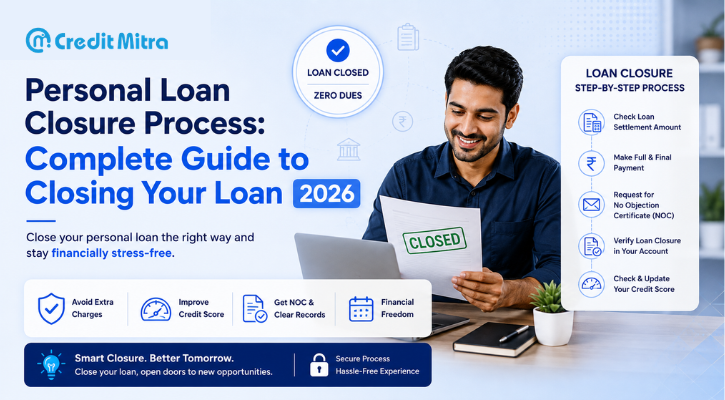
You've paid your last EMI. Five years of disciplined monthly payments, finally done.
But here's what most borrowers get wrong: paying the last EMI is NOT the same as closing your loan.
There are still four things you must do after that final payment to make your loan closure official, protect your CIBIL score, and avoid problems years down the line.
This guide covers everything, normal closure after tenure, pre-closure (paying off early), charges by bank, the loan closure certificate, the letter format, and the documents you must collect.
What Is Loan Closure?
Loan closure means formally ending your loan agreement with the lender, either after completing all scheduled EMIs (regular closure) or by paying off the outstanding amount before the tenure ends (pre-closure/foreclosure).
Two types:
1. Regular Closure: All EMIs paid as per schedule. Loan ends on its original end date.
2. Pre-Closure (Foreclosure): You pay the full outstanding principal before tenure ends, ending the loan early.
Both require the same post-payment steps to make closure official.
Why Loan Closure Is More Than Just Paying EMIs
When you pre-close your HDFC Bank personal loan, you save money on interest by paying it off at once. You will also reduce your long-term debt, eliminating your obligation to make monthly EMIs and improving your cash flow. In addition, pre-closures can improve your debt-to-income ratio, which may help you qualify for future financing more easily.
But the process doesn't end at payment. After your last payment (regular or pre-closure), you must:
Get Loan Closure Certificate (formal closure confirmation)
Collect NOC (No Objection Certificate)
Verify CIBIL update (loan shows "Closed" not "Active")
Return/verify documents (for secured loans)
Skipping any of these steps creates problems, CIBIL continues showing active loans, future lenders question open obligations, and you lose legal protection.
Pre-Closure vs Regular Closure: Key Differences
Is pre-closure worth it? Calculate first:
Example: ₹5 lakh loan, 36 months, 14%, closing at month 24
Outstanding principal at month 24: ~₹1,87,000
Interest remaining if continued: ~₹22,400
Pre-closure charge (3%): ₹5,610
Net savings: ₹22,400 - ₹5,610 = ₹16,790
Pre-closure is worth it. But if charges exceed interest savings, don't close early.
HDFC Loan Closure: Pre-Closure Charges & Process
HDFC Bank personal loan foreclosure charges range from 2% to 4% of the outstanding principal + GST. Allowed only after 12 EMIs , 4% (13-24 months), 3% (25-36 months), 2% (36+ months).
HDFC Pre-Closure Charges (2026):
Pre-closure or part prepayment can be done only after 12 EMIs are paid. Part prepayment of up to 25% of the principal outstanding will be allowed. Part-payment can be done once in a financial year and twice during the whole tenure.
HDFC Pre-Closure Process (Step-by-Step):
Contact HDFC Bank: Get in touch with an HDFC Bank representative to express your intention to pre-pay your personal loan. Payment: Make the pre-payment by providing a cheque or a demand draft at any HDFC Bank branch. Cash payments above ₹49,000 are not accepted; alternative methods such as pay orders, account payee cheques, or demand drafts are required.
Call HDFC customer care (1800 1600) or visit branch
Request pre-closure statement (current outstanding + applicable charges)
Arrange payment via cheque/DD/NEFT (not cash >₹49,000)
Submit payment at branch
Get acknowledgment receipt immediately
Collect Loan Closure Certificate + NOC (7-15 days)
HDFC Note: HDFC personal loan prepayment online is not available. Pre-closure must be done offline at a branch.
Read More: Personal Loan Foreclosure Charges 2026
IDFC FIRST Bank Loan Closure Process
IDFC FIRST offers more flexible pre-closure terms than HDFC.
IDFC Pre-Closure Charges:
After 1 EMI: 5% of outstanding principal
After 6 months: 4% of outstanding
After 12 months: 3% of outstanding
After 24 months: 2% of outstanding
IDFC Pre-Closure Process:
Log in to IDFC FIRST Bank app or website
Go to "Loans" → select your personal loan
Click "Foreclose Loan" (available online, unlike HDFC)
View pre-closure amount (principal + charges + interest to date)
Make payment via net banking/UPI
Digital NOC issued within 3-7 days
IDFC Advantage: Full online process, no branch visit required.
Pre-Closure Charges Across Major Lenders (2026)
Important: RBI mandated zero pre-closure charges for floating rate personal loans from January 2026. Fixed rate loans still carry charges. Most personal loans are fixed rate, verify your loan type before assuming zero charges.
How to Calculate Pre-Closure Savings
Before pre-closing, always calculate:
Formula: Net savings = (Remaining interest) - (Pre-closure charge + GST)
Example: ₹3 lakh loan, 14%, 36-month tenure, closing at month 18
Step 1: Outstanding principal at month 18 ≈ ₹1,62,000
Step 2: Remaining interest (18 months) ≈ ₹19,440
Step 3: Pre-closure charge (3% of ₹1,62,000) = ₹4,860 + GST (18%) = ₹5,735
Step 4: Net savings = ₹19,440 - ₹5,735 = ₹13,705
Decision: Net savings positive → pre-close. Net savings negative → continue EMIs.
Loan Closure Letter: What It Is & When You Need It
A loan closure letter (also called closure request letter) is a written request you submit to your lender asking them to close your loan account after full payment.
When you need it:
When bank requires written confirmation before processing closure
When requesting pre-closure initiation
For your own records
Loan Closure Letter Format Sample:
[Your Name] [Address] [Date]
To, The Branch Manager / Loan Department [Bank Name] [Branch Address]
Subject: Request for Closure of Personal Loan Account Number [XXXXXX]
Dear Sir/Madam,
I, [Your Full Name], hold a personal loan account bearing number [Loan Account Number] with your bank. I have successfully repaid all outstanding dues, including the principal, interest, and applicable charges as of [Date of Final Payment].
I hereby request you to formally close my loan account and issue:
Loan Closure Certificate confirming full repayment
No Objection Certificate (NOC)
Updated CIBIL reporting confirming loan closure
Please find enclosed:
Copy of final payment receipt/bank statement
Copy of PAN card
Copy of Aadhaar card
Kindly process this request at the earliest.
Yours sincerely, [Your Full Name] [Mobile Number] [Email Address]
This letter is for regular closure after final EMI. For pre-closure, modify to request a pre-closure statement first.
Loan Closure Certificate: What It Contains & Why You Need It
The loan closure certificate is the official document confirming your loan is fully paid and closed.
What it contains:
Your full name and loan account number
Original loan amount
Date of final payment
Confirmation of zero outstanding dues
Bank's official stamp and authorized signature
Why you must have it:
CIBIL evidence: If CIBIL doesn't update, use this to raise dispute
Future loan applications: Proof you have no active obligations
Legal protection: Bank cannot claim future dues against you
Property/vehicle transactions: Required to prove clean title
How long to get it:
Private banks (HDFC, ICICI, Axis): 7-15 working days
PSU banks (SBI, PNB): 15-30 working days
Fintech/NBFC: 3-7 working days (often instant digitally)
Documents to Collect After Loan Closure
For unsecured personal loans:
✅ Loan closure certificate
✅ NOC (No Objection Certificate)
✅ Final payment receipt
✅ Loan account statement (showing zero balance)
For secured loans (home loan, car loan):
✅ All above +
✅ Original property documents (returned within 30 days per RBI)
✅ Vehicle RC hypothecation removal form (Form 35) for car loans
Read More: Loan Repayment Strategies: Repay Faster & Save Lakhs
CIBIL Update After Loan Closure: Critical Step
After receiving closure certificate, verify CIBIL update:
Timeline: CIBIL typically updates within 30-45 days of loan closure
How to verify:
Download CIBIL report from cibil.com after 45 days
Find your loan in "Accounts" section
Verify status shows "Closed" not "Active"
Outstanding balance should show ₹0
If CIBIL still shows active after 45 days:
Raise dispute on cibil.com with closure certificate as proof
CIBIL investigates within 30 days
Report corrected
Why this matters: Active closed loan in CIBIL reduces your available debt capacity, potentially causing future loan rejections or higher rates.
Part-Payment vs Pre-Closure: Which Is Better?
Part-payment: Pay a lump sum toward principal (reduces outstanding, not full closure)
Pre-closure: Pay full outstanding, completely closed loan
You may part-prepay the personal loan only after completing the first EMI. It is allowed once per financial year and twice during the loan tenure, up to 25% of the principal outstanding. Applicable charges will match full closure charges based on your EMI count.
When part-payment is better:
You have surplus but not enough for full closure
Reduces EMI or tenure going forward
Spreads pre-closure benefits over time
When pre-closure is better:
Full surplus available
Net savings calculation positive
Want to completely eliminate monthly obligation
Planning new loan (better debt-to-income ratio)
FAQ: Loan Closure Questions Answered
Q: Can I pre-close an HDFC personal loan online?
A: No, the facility of HDFC personal loan prepayment online is not available. Pre-closure must be done at a branch. Contact HDFC customer care first to get your pre-closure quote before visiting.
Q: What happens if I don't collect NOC after loan closure?
A: CIBIL may continue showing active loans for years. You'll face complications selling property/vehicle and applying for future loans. Always collect NOC within 30 days of closure.
Q: Is pre-closure always beneficial?
A: Not always. Be cautious about using your existing investments to pre-pay the loan, as this could impact your emergency fund. Always calculate: if pre-closure charges exceed remaining interest savings, continue EMIs instead.
Q: How long does HDFC take to issue a closure certificate?
A: When HDFC has successfully processed your prepayment request, they will send you a loan closure confirmation and/or no objection letter (NOC) for your files. Typically 7-15 working days after payment confirmation.
Q: Does pre-closing a loan improve CIBIL?
A: Marginally. Closing a loan frees up debt capacity and removes the obligation. Consistent on-time payments throughout tenure has already done the positive CIBIL work. Pre-closure itself neither significantly helps nor hurts, the repayment history is what counts.
Q: Can I reopen a closed loan account?
A: No. Once closed, you must apply for a fresh loan. This is why some borrowers prefer part-payment over full pre-closure, maintaining relationships with lenders for faster future approvals.
Loan Closure Checklist: Your Action Plan
After final EMI or pre-closure payment:
☐ Get acknowledgment of final payment from bank immediately
☐ Request loan closure certificate (written or via app)
☐ Request NOC simultaneously
☐ For car loan: Visit RTO with NOC + Form 35 within 30 days
☐ For home loan: Collect all original property documents
☐ Save digital copy of closure certificate (email to yourself)
☐ Check CIBIL after 45 days (should show "Closed")
☐ Raise CIBIL dispute if still showing active after 45 days
☐ Keep closure certificate permanently (needed years later)
Conclusion: Loan Closure Is a Process, Not Just a Payment
Paying your last EMI is the milestone. But formal loan closure is the process that protects you legally, updates your CIBIL accurately, and enables better financial options in the future.
Three things to remember:
Always collect closure certificate + NOC , don't assume bank will send automatically
Verify CIBIL update after 45 days , dispute if still showing active
Calculate before pre-closing , charges must be less than interest savings
And when you're ready for your next loan, whether for home renovation, a vehicle, wedding, or emergency, CreditMitra offers instant personal loans up to ₹5 lakh with complete digital processing. Your clean loan closure history makes you an ideal borrower for better rates.
About the Author

Divya Kumari
SEO Strategist & Finance WriterDivya Kumari is an SEO & Content Strategist with experience in organic traffic growth, topical authority building, and content-led SEO strategies. She specializes in creating user-focused content for finance and SaaS websites, helping brands improve visibility through structured content planning, internal linking, and search optimization techniques.
Borrow. Protect. Grow.
All in one app.
- Compare loan offers
- Buy insurance in minutes
- Invest in mutual funds
- Check credit score free
- Track all your applications


Explore More Articles

What to Do When Your Travel Budget Falls Short

How to Finance Your Dream Vacation Responsibly
On this page
- What Is Loan Closure?
- Why Loan Closure Is More Than Just Paying EMIs
- Pre-Closure vs Regular Closure: Key Differences
- HDFC Loan Closure: Pre-Closure Charges & Process
- IDFC FIRST Bank Loan Closure Process
- Pre-Closure Charges Across Major Lenders (2026)
- How to Calculate Pre-Closure Savings
- Loan Closure Letter: What It Is & When You Need It
- Loan Closure Certificate: What It Contains & Why You Need It
- Documents to Collect After Loan Closure
- CIBIL Update After Loan Closure: Critical Step
- Part-Payment vs Pre-Closure: Which Is Better?
- FAQ: Loan Closure Questions Answered
- Loan Closure Checklist: Your Action Plan
- Conclusion: Loan Closure Is a Process, Not Just a Payment
About the Author
Divya Kumari
SEO Strategist & Finance WriterDivya Kumari is an SEO & Content Strategist with experience in organic traffic growth, topical authority building, and content-led SEO strategies. She specializes in creating user-focused content for finance and SaaS websites, helping brands improve visibility through structured content planning, internal linking, and search optimization techniques.
Borrow. Protect. Grow.
All in one app.
- Compare loan offers
- Buy insurance in minutes
- Invest in mutual funds
- Check credit score free
- Track all your applications