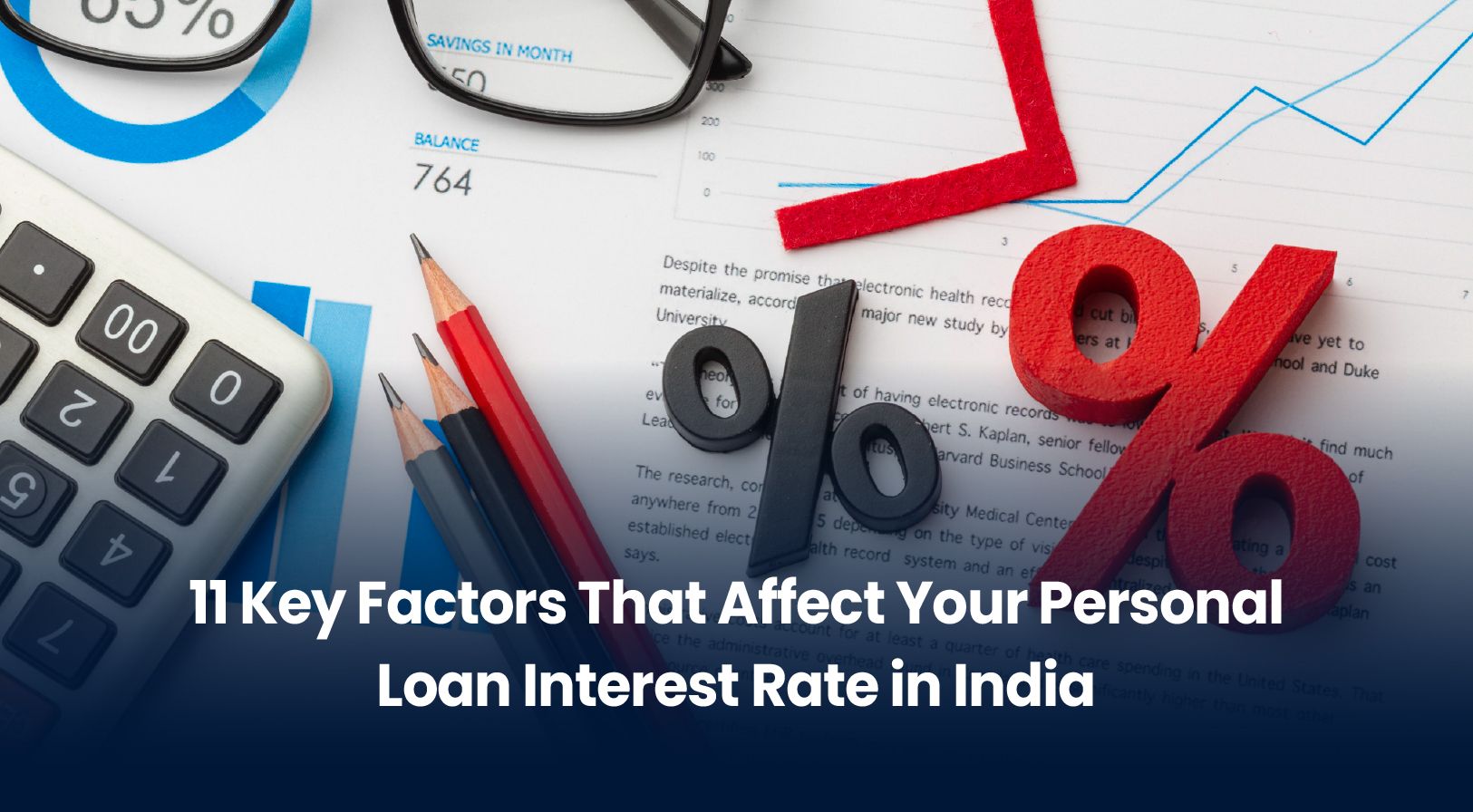
11 Key Factors That Affect Your Personal Loan Interest Rate in India (2026 Guide)
Personal loans are most popular financial instruments. It provides affordability and instant access to funds for covering expenses such as weddings, medical emergencies, home renovation, travel, or debt consolidation etc. Secured loans like home or auto loans have lower risk, personal loans are unsecured, and risk is higher. So, the interest rates of personal loans is higher and differ widely from one borrower to another.
It is vital to know what determines your interest rate on your personal loan in order to have the best overall deal with it, as well as repaying it efficiently. In the following guide to interest rates, we will explore 11 major reasons that influence interest rates in India, how lenders consider them, and recommendations on how to obtain better terms of borrowing.
1. Credit Score (CIBIL or Other Scores)
Your credit score is one of the biggest determining factors of what interest rate you will be offered.
- High Score (750+): Interest Rates will be Lower, Chances of Approval is high.
- Average Score (650-749): Standard interest rate, Conditional Approval
- Low Score (<650): Higher interest rate, Risk of rejection
Why it is important: Banks are interested in a good credit score, as it indicates their financial discipline and on-time repayment habits. A good score gives the lenders the confidence that you are a less likely to default, and therefore reduces their interest rates.
Tip: Check your CIBIL score before making any application, and clear off any pending dues to improve your score.
2. Income and Employment Stability
Lenders check your monthly income, the type of job you have, and the stability of your employment while making a decision about your interest rate.
- High income and stable employment: Lower interest rate, high eligibility for loans
- Frequent Job Changes or Probationary Period: Higher rate of interest or smaller loan amount
- Self-employed persons: Slightly higher charge because their income is irregular.
Tip: Giving salary slips, bank statements or income proof will help lenders to accurately understand your repayment capacity and provide you with the best possible rates.
3. Loan Amount and Tenure
The amount of loan and the repayment period directly influences the interest rates:
- Small loan amount(<₹2 lakh): Higher interest rates (risk for lender)
- Large loan amount (>₹5 lakh): The rates may be lower after taking into consideration the borrower has high income as well as good credit history
- Reduced tenure: Higher EMIs but Lower total interest cost
- Long tenure: EMIs are less, interest accumulative is greater.
Tip: Balance the tenure and EMI affordability between in order to be free from paying overall more points in interest.
4. Type of Lender
Different lenders have different interest rates structures:
- Banks: Typically have lower rates of interest (10-18%) for salaried people who have a good credit score
- NBFCs: It costs a little more, approximately 12-22%, but has more relaxed eligibility requirements.
- Digital Lending Platforms: Borrowers should be able to get an instant personal loan with competitive rates, depending on the borrower’s profile.
Hint: Lenders should be compared. Money Lending websites serve to find the most attractive lenders who provide the individual with the best rates.
5. Loan Purpose
Even though personal loans are unsecured and therefore do not typically require proof of usage, some lenders charge lower rates for specific purposes:
- Home renovation or education loans might get slightly better rates.
- Debt consolidation loans can have lower interest rates if used to settle multiple high-interest loans.
Tip: Be honest about your purpose for the loan, and see if there are any specific offers from the lender that will meet your needs.
6. Past Credit History and Current Debts
Lenders have a look at your current financial obligations and also your repayment history:
- Multiple ongoing loans or having a high credit card utilization may mean higher perceived risk levels, which will result in higher interest rates
- No existing loans or a low debt-to-income ratio increases the chances of lower interest rates
Tip: Keep a good debt: Income ratio, preferably lower than 40-50%, before applying for a personal loan.
7. Age of the Borrower
General factor: Age is a fine yet significant aspect:
- Young borrowers (21-35): They usually have more favourable rates when they are in constant jobs.
- Borrowers in the middle-aged (35-50): The company could provide decent rates because of clarity in income and repayment abilities.
- Older borrowers (50-60): In some cases, there is a perception of greater risk in lending, and especially in lending for shorter periods
Tip: Make sure that the tenure you pick matches your retirement or employment horizon in order to increase the chances of approval.
8. Type of Employment
Employment type has an impact on interest rates:
- Salaried individuals: Lower rates of interest due to predictable income
- Government employees: Have the luxury of receiving preferential rates because of job security
- Self-employed professionals/business owners: Rates can be slightly higher, though higher amounts of loan are available with proven income.
- Contractual or other gig workers: Interest rates or more rigorous checks.
Tip: You can give detailed income proof (bank statement, tax returns, contracts with clients – if you are a freelancer or self-employed) for better rates.
9. Relationship against the Lender
Selected banking relationships are power to influence interest rates:
- Salary account holders can enjoy special offers or pre-approved loans
- Long-standing customers with good transaction history may get reduced interest rates
- Multiple products by the same lender (savings, credit card, FD) can help to negotiate for better terms
Tip: Check for some pre-approved loan offers and discounts by your bank or NBFC.
10. Processing Fees/ Other Charges
Though not part of the interest rate, processing fees, service charges and insurance costs have an impact on the effective rate of interest (EIR):
- Banks/NBFCs can charge 1 – 2% processing fees
- Some digital lenders are charging service or convenience fees
- These charges being taken into account when crunching EMI figures will produce a true picture of borrowing cost
Tip: You should always take EIR into consideration rather than the stated rate of interest when comparing lenders.
11. Economic Conditions and Market Conditions
There are other financial factors which influence interest rates:
- Repo rate by RBI: If repo rates increase, lenders tend to charge higher personal loan interest rates
- Inflation and liquidity of the market: May cause unstable rates.
- Bank policies: Internal risk assessment and capital cost effect rates
Tip: Keep a check on the announcements of RBIs repo rate and lender offers so that you can apply when it sees a favorable movement.
How to get the lowest personal loan interest rate.
Taking a look at what factors are above, there are steps you can take to improve your loan terms:
A. Improve Your Credit Score
- Pay EMIs and credit card bills within time
- Keep the credit utilization low (less than 30%)
- Don’t make a number of hard inquiries before applying
B. Have Shorter Tenure whenever possible.
- Shortened repayment periods result in less debt for interest
- EMIs are increased; however, long-term savings are hardly negligible.
C. Reduce Existing Debt
- Clear high-interest loans / credit card balances
- Have a healthy debt-to-income ratio
D. Compare Multiple Lenders
- Get an instant comparison done through sites
- Evaluate interest rates, processing charges, and tenure
E. Check Pre-approved Loan offers
- Pre-approved loans for existing bank customers will often include lower interest rates
- Check for offers associated with salary accounts, fixed deposits, or previous loan history
F. Have Full Documentation.
- Salary slip, bank statement, PAN, Aadhaar, and Employment Proof
- Shortens the processing times and improves approvals
Facts and Myths on the interest rates of personal loans
Myth 1: There is same interest rate that is offered by all Lenders.
Reality: Interest rates differ from the banks to NBFCs, and to digital lenders.
Myth 2: High Income Individuals are guaranteed of obtaining low-interest rates.
Reality: Income is important, but CIBIL score, existing debts and the amount of loan are also important.
Myth 3: Banks are the only alternative that offers low cost loans.
Fact: NBFCs and online lenders tend to be competitive with quicker processing.
Myth 4: The Interest rate is not influenced by the purpose why one is taking the loan.
Reality: There are slightly better rates offered on certain uses by some lenders, such as home improvement, education, or to consolidate various debts.
How to Minimise the Interest rate in Personal loans.
- Maintain a Strong CIBIL Score – More than 750 score is ideal.
- Clear Current High-Interest Debts – Minimizes calculated risk.
- Use Salary Account or Existing Bank Relationship – Pre-approved offers are often lower-rate offers.
- Choose a Short Tenure if it is Affordable – Save on the total interest paid
- Compare Multiple Lenders- Compare and find the lower rates.
- Check NBFC or the Digital Lenders – Fast disbursal and Flexible criteria.
- Negotiate Processing Fees – Some lenders cut down the processing charges that will reduce the effective price.
Final Thoughts
Personal loan interest rate depends on a range of factors, including borrower-specific factors and market conditions. By knowing these 11 most important factors – credit score, income, employment stability, loan amount, term, lender type, loan purpose, past credit performance, age, type of employment, and processing fees – deciding which ones are the most strategic to you, you can take strategic measures to get the best rate.
Key takeaways for borrowers:
- Improve your credit score before applying with an lower credit score.
- Have stable employment and Income related documents.
- Compare a number of lenders for the best rates
- Borrow only what is absolutely necessary so as to avoid excessive interest.
- Plan tenure and EMIs for an affordable balance of total interest cost
Borrowers can compare lenders, check eligibility, and get pre-approved personal loan offers based on their profile. But with careful planning, you can lower interest burden, get your files approved faster, and efficiently manage repayments.
Understanding these factors helps to ensure that your personal loan is a smart financial solution that can help you meet near-due urgent expenses without being unnecessarily financially stressed out.

How to Get a Personal Loan Approved Fast in India (2026 Guide)
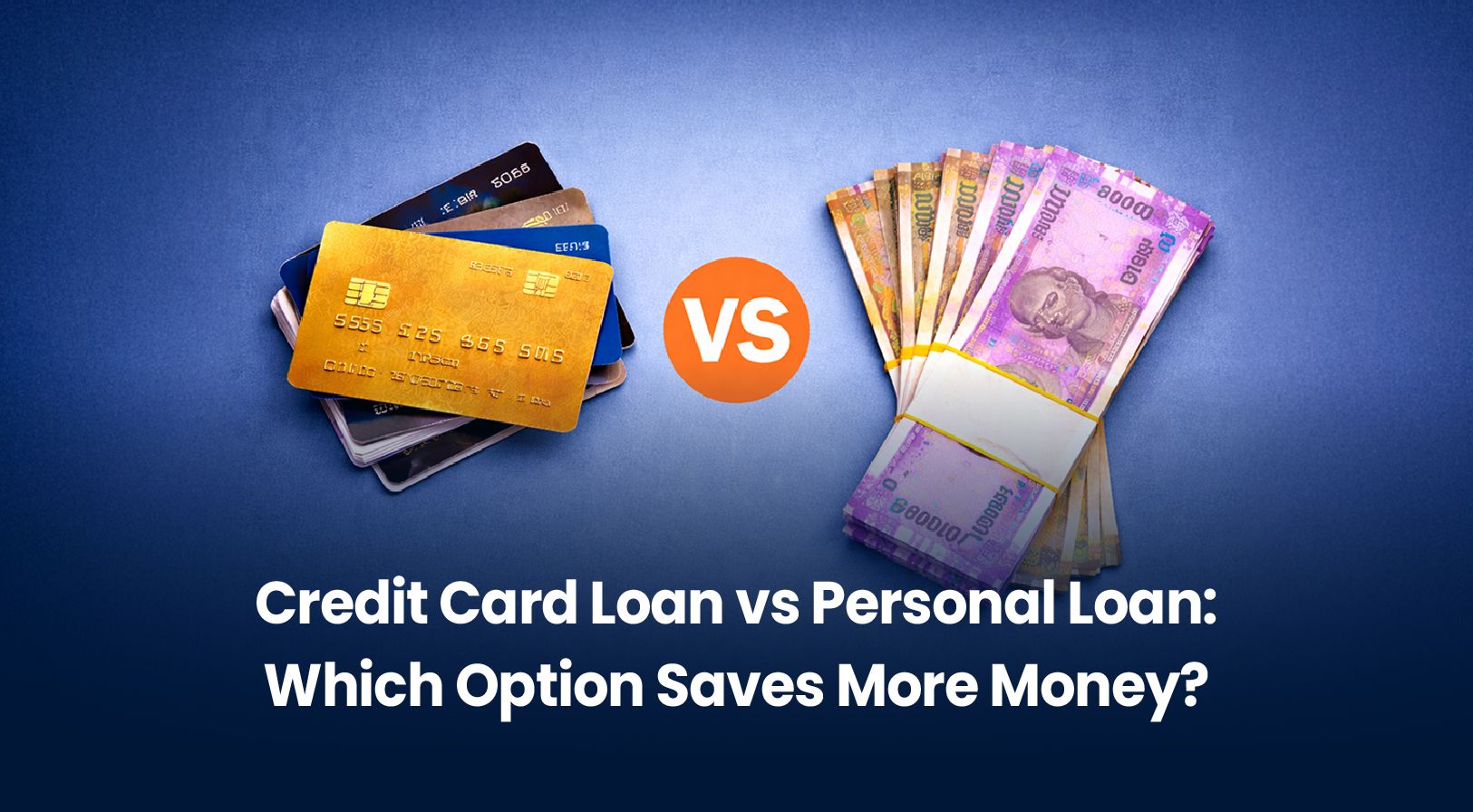
Credit Card Loan vs Personal Loan: Which Option Saves More Money?